What Happens to Your Chinese Company When Its Actual Controller Dies
Death does not transfer control. It removes the only person who could explain the arrangement — and hands the problem to people who have never seen the documents.
PRC law position reviewed as of .
A shareholder dies. The shares pass to the heirs. Someone updates the register. Foreign investors expect roughly that sequence, and in a debt-free company with clean ownership, they mostly get it.
I have never seen it work that way in a company with an actual controller.
The controller is the person who really decides — who holds the chops, instructs the legal representative, and knows which shares are held for whom. Very little of that appears on the register. While he is alive, the gap costs nothing. His death closes the gap in a single day, at the exact moment the one person who could explain it is gone.
What follows is not a succession problem. It is a control problem, a liability problem, and sometimes an insolvency problem, all arriving together. Treating it as paperwork is how investors lose a year and a great deal of money.
| Risk area | When it bites | Who ends up paying |
|---|---|---|
| Nobody can vote the shares | Days | The company — it cannot restructure or refinance |
| Chops and credentials held personally | Hours | Whoever is not holding them |
| Nominee arrangements surface | Weeks | The estate, and any silent beneficial owner |
| Guarantees become estate debts | On acceleration | The family, up to the value of the estate |
| Company is itself insolvent | Immediately | Directors, through conduct after the fact |
The three questions that never move together
One tool does most of the work here. Separate the situation into three questions, and resist the instinct to answer them as one.
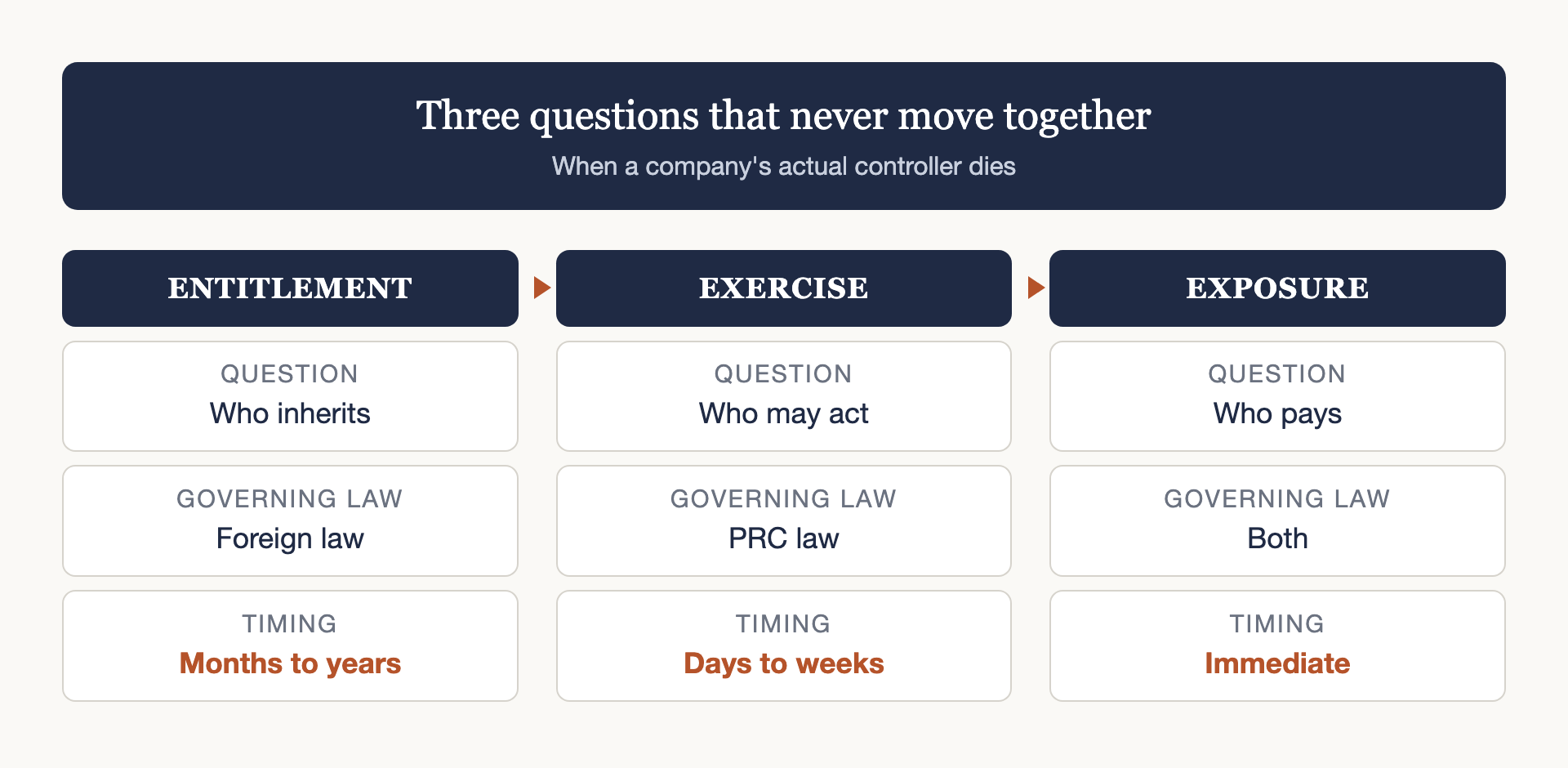
Entitlement asks who takes the equity as property. Article 31 of the PRC Law on the Application of Law to Foreign-Related Civil Relations points statutory succession to the law of the deceased's habitual residence at death. Equity in a PRC company is not immovable property, so the lex situs exception does not rescue you. If the controller had relocated abroad, a foreign law governs — and in a federal state, a provincial or state law rather than a national one. Article 9 excludes renvoi, so the foreign substantive rules apply directly.
Exercise asks who may act as a shareholder inside the company. That question stays with PRC law and the articles of association, whatever governs entitlement.
Exposure asks who carries the obligations attached to the holding — guarantees, unpaid capital, controller status. Exposure does not wait for the other two. It crystallizes the moment a lender accelerates.
The three answers arrive at wildly different speeds, from different legal systems, and they do not wait for each other. Most of the damage in these matters happens in the gap.
Nobody can vote the shares
The risk: Article 90 of the PRC Company Law lets lawful heirs succeed to shareholder qualification unless the articles say otherwise. That sentence resolves entitlement. It does nothing about exercise.
Until someone produces documents establishing entitlement — a judgment, a notarized succession certificate, a grant of administration — no one can validly vote that holding. The shares also cannot simply be stripped out of the voting base to make the arithmetic work. Deduct them without clear legal, constitutional or judicial authority and you have handed the other side grounds to void the resolution.
Two-thirds matters go first. Amending the articles, changing registered capital, merger, division, dissolution, change of corporate form — all of it stalls under Article 66 if the blocked holding is large enough. A company that cannot pass a resolution cannot restructure, cannot refinance, and often cannot change its own bank signatory.
Practical takeaway: Calculate, on day one, which resolutions your remaining shareholders can still pass without the frozen holding — that number determines everything you can do for the next six months.
Whoever holds the chops holds the company
Why this one is different: every other risk here is legal. This one is physical.
Chinese corporate practice concentrates enormous authority in objects. The company chop, the contract chop, the finance chop, the banking token, the tax control device, the electronic business licence credentials. One individual frequently holds all of them — the controller, or someone reporting only to him. Custody, not title, determines who can act on Monday morning.
The same applies to books and records. Where the accounting records and the corporate record set sat under the controller's personal control, they can become inaccessible overnight. Under PRC insolvency law, loss of books exposes the legal representative and responsible officers personally, and the excuse that a deceased person held them does not travel far.
In my experience, the first week of these matters is decided almost entirely by who is physically holding the chops. Legal entitlement catches up eventually. It rarely catches up before the damage is done.
Practical takeaway: Secure and inventory the chops, tokens, devices and record set within seventy-two hours, with a signed custody log — it protects your position better than any filing.
Nominee arrangements surface — and you are probably checking only one direction
The trap: nominee shareholding is common in China and generally lawful. Courts treat the arrangement as valid between the parties, absent specific invalidating grounds. Death is when it stops being an internal matter.
The internal and external analyses point in opposite directions. Internally, the agreement survives the death. It does not convert nominee-held equity into a substantive asset of the estate, and the estate representative is generally expected to honour it. Externally, the register largely prevails. Where creditors of the nominee enforce against equity registered in the nominee's name, PRC courts apply commercial appearance principles strictly, and objections by the beneficial owner usually fail. Some divergence exists where the enforcing creditor never relied on the register — a tort claimant, for instance — but I would not promise anyone that outcome.
An insolvent nominee's estate can therefore lose the benefit of equity it never really owned while remaining exposed to a claim from the beneficial owner for failing to deliver it. Both sides of the same transaction, both losing.
If I had to name the single most underweighted risk in this entire area, it is not that one. It is the arrangement running the other way — someone holding shares for the deceased. Advisers ask the first question by reflex and skip the second almost every time. Shares held for the deceased appear nowhere on any register, exist only in contract, and depend on a surviving nominee who now has every incentive to say nothing. It is the easiest asset in an estate to lose, and the loss is usually silent.
Questions worth asking: who paid the subscription money, and from which account? Who has actually received dividends? Whose instructions did the registered holder follow at shareholder meetings? Where are the original agreements physically kept?
Practical takeaway: Run the nominee search in both directions within the first ten days, and secure the original agreements and payment trail before anyone has time to reconsider their position.
The guarantee outlives the guarantor
Chinese banks routinely require founders, controlling shareholders and directors to give joint and several guarantees for corporate borrowing. Foreign investors see the loan documents and rarely register what the personal guarantee schedule means.
On death, the guarantee obligation becomes an estate debt. If the borrower defaults, the liability crystallizes at once. Many facilities also let the lender accelerate on the death itself, long before any succession question gets resolved.
Article 1161 of the PRC Civil Code caps heirs' liability at the actual value of the estate received, and an heir who renounces the succession is not liable at all. But where a foreign law governs succession, that foreign law sets the mechanics and the deadline for renunciation. Overseas family members routinely discover the deadline after it has expired. Where an estate looks net negative, getting this advice early is the highest-value thing anyone can do for the family, and it costs almost nothing.
Unpaid capital travels the same way. Where registered capital was never fully paid, or was paid and later withdrawn, the exposure attaches to the equity and follows it. In insolvency, an administrator can call unpaid contributions regardless of the subscription deadline in the articles. What protects an estate is documentary proof that the money went in and stayed in: bank records, vouchers, and the flow of funds in the months after payment. Withdrawal shows up there.
Investors often assume the register is what creates exposure. Consumption restriction measures reach the legal representative, the persons directly responsible for performance, and the actual controller. Staying off the register is not protection.
Practical takeaway: Map every personal guarantee and the capital contribution history in week one, and tell the family about the renunciation deadline before you tell them anything else.
If the company is itself insolvent, reverse the order
Everything above assumes a viable company. Article 2 of the Enterprise Bankruptcy Law sets the test: unable to pay debts as they fall due, with insufficient assets or a manifest inability to pay. Where a company meets it, the instinct to get the shares transferred first turns actively harmful.
My default position is to treat the registration change as the last step, not the first. Transferring equity while enforcement measures sit on it, shortly after the holder's death and insolvency, invites a challenge that responsible property was moved beyond creditors' reach. Solvency also does not depend on who inherits, so nothing about it should wait for a foreign estate process. And once proceedings open, the administrator takes the property, chops, books and documents anyway. The administrator can investigate capital contributions and related-party dealings. The administrator can also avoid gratuitous transfers, sales at manifestly unreasonable prices, and preferential payments made inside the statutory look-back periods.
Directors' liability is the point I most often see overstated, usually by advisers importing wrongful trading instincts from home. PRC law imposes no general standalone duty to file for bankruptcy the moment a company becomes balance-sheet insolvent; the statutory language is permissive. Article 125 requires a breach of the duties of loyalty and diligence that caused the bankruptcy. Exposure attaches to conduct while insolvent — new debt without prospect of repayment, preferring related creditors, disposing of assets at undervalue, losing the records — not to the filing date.
Where the company is already insolvent, incidentally, the fight over nominee shares stops being about value. The equity may be worth nothing. What the arrangement still determines is who counts as the controller, and therefore who carries the controller's exposure.
Practical takeaway: Assess the company's solvency as a separate workstream on a separate clock, and freeze all registration activity until you know the answer.
The fix almost nobody drafts
Article 90 permits the articles of association to displace the default rule. In perhaps a decade of looking at these documents, I have rarely seen a company use it.
Silence means heirs succeed to shareholder qualification, which is almost never what a joint venture partner would have chosen. The alternatives take a paragraph each: heirs take economic value but not qualification; a buy-back or compulsory transfer with a pre-agreed valuation method; multiple heirs required to appoint one representative to exercise rights. Add key-man call and put options, transfer restrictions, and a deadlock mechanism that still functions when one bloc temporarily cannot vote.
Operationally, separate custody of chops and banking credentials from any single individual, maintain a written authority matrix, and keep a complete duplicate record set outside the founder's control. Unglamorous, and decisive in week one.
What actually needs checking at diligence: ask directly whether any equity is held for another person, in either direction, and take a specific warranty and indemnity on the answer. Identify the actual controller as a matter of substance. Map the personal guarantees — they tell you where the real pressure will land.
Practical takeaway: Spend the two hours on the articles at signing, because the same issue costs a year of governance paralysis if you leave it to the default rule.
Key takeaways
- Run the entitlement / exercise / exposure split immediately. Different laws, different speeds, and exposure never waits for the other two.
- Ask who is holding shares for the deceased, not only who the deceased was holding for. That asset is invisible on the register and disappears quietly.
- Secure the chops, tokens and record set within seventy-two hours. Custody beats title in the only week that matters.
- Tell the family about the renunciation deadline before anything else, and confirm it under the foreign law that actually governs.
- Where the company is insolvent, make registration the last step and solvency the first. Reverse that order and you create avoidance risk instead of solving anything.
The cases that go badly are almost never the ones with a genuine inheritance dispute. They are the ones where nobody could answer three simple questions: who really owns this, who really decides, and who has personally signed for it. The only person who knew had died. Nobody had thought to write it down while asking was still possible.
General knowledge resource on PRC law, not advice on any actual matter. Cross-border succession turns heavily on the governing foreign law, so take advice in both jurisdictions before acting.
Related Legal Analysis
- Every Investment Was Approved. More Than RMB 190 Billion Still Reached the Controlling Shareholder.
GovernanceAnalysis14 min read
- The Building Was in the Lot. The Hotel Was Not.
Distressed AssetsAnalysis15 min read
- Your Chinese Supplier Will Show You Anything. Ask It to Agree to Something Instead.
Commercial DisputesAnalysis15 min read
Related Practice Areas
If your business is facing similar issues, please contact me to discuss how I may assist.