The Hidden Legal Risks in Acquiring a China Data Center — Part A: License, Ownership & Deal Structure
Part A of a three-part series on acquiring a China data center: why these are deals for scarce, regulated rights rather than real estate, and how the operating license and foreign-investment access decide whether the transaction can happen at all.
PRC law position reviewed as of .
Part A: License, Ownership, and Choosing the Right Deal Structure
Most China data center acquisitions are priced as infrastructure deals. Legally, they are not.
Buyers underwrite a building, a row of racks, a power bill. What they are actually buying is a bundle of scarce, regulated rights — a telecom license, an energy quota, a guaranteed slice of power capacity, a set of carrier connections, a customer base that can walk the day the shareholding changes. Pull any one of those out of the bundle, and the number on the term sheet does not survive closing. I have seen this happen. It is rarely the thing anyone flagged in the data room.
This is Part A of a three-part series. Part A sets out the framework I use on every one of these deals, then walks through the two issues that decide whether the transaction can happen at all: the license, and foreign investment access. Part B covers the physical infrastructure risks that a standard document review consistently misses. Part C covers the money and the people.
Quick reference — what this part covers:
| Risk Area | Deal-Breaker? | Where It Bites |
|---|---|---|
| License / operating-entity mismatch | Yes | Revenue legality, license does not transfer with assets |
| Foreign investment access | Yes | Deal approval, control structure, cross-border payment |
The Three-Layer Test
Here is the habit that catches more problems than any checklist: for every core asset the target holds, ask three separate questions, and refuse to let a good answer to one substitute for the others.
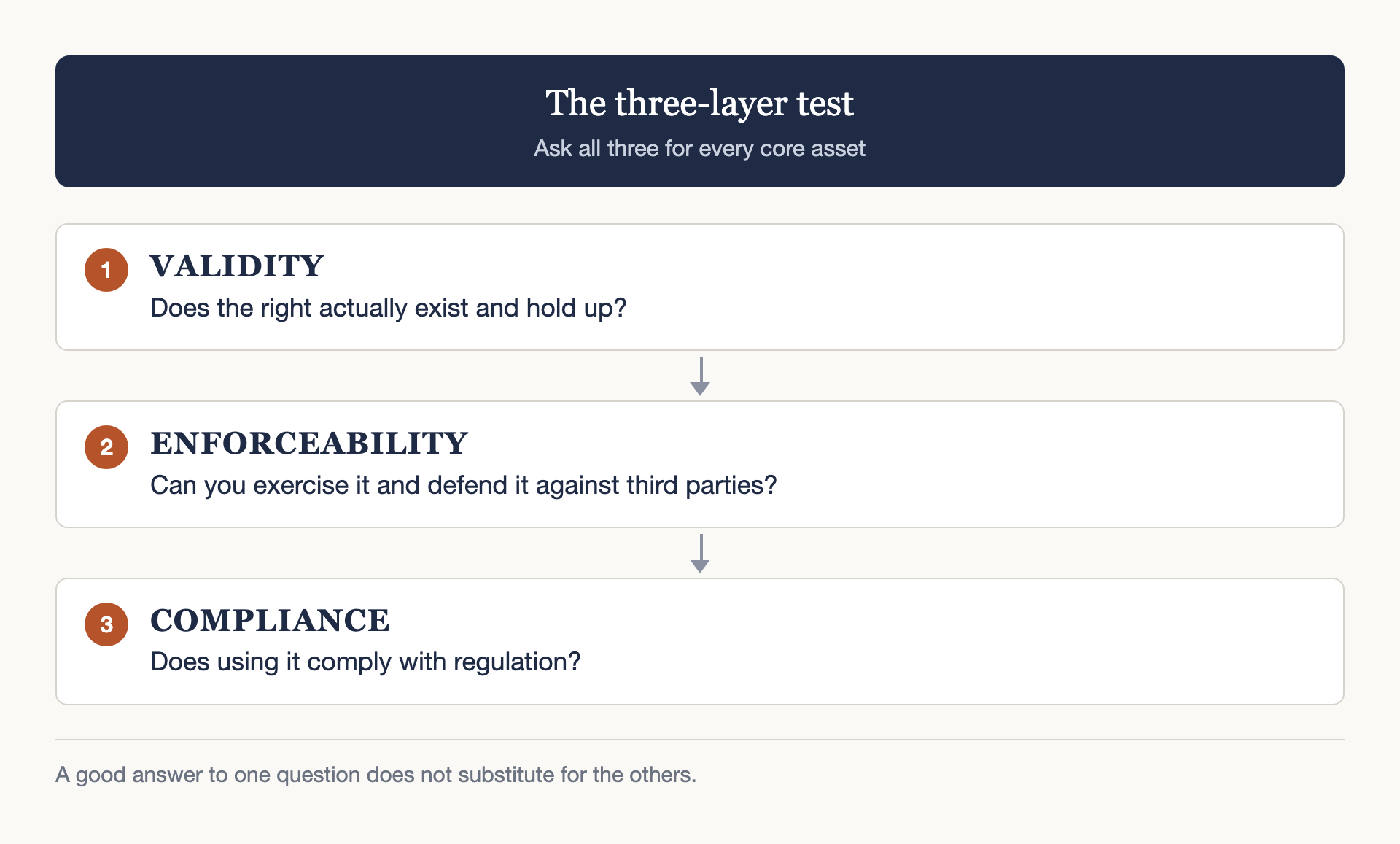
- Validity. Does the contract, license, or title actually exist and hold up on its own terms?
- Enforceability. Can it be exercised and defended against third parties? Would it survive a competing claim, a prior lien, a registration dispute?
- Compliance. Does using it comply with regulatory requirements? Does a change of control trigger a filing, an approval, or a clawback?
I run this test on every element of a target's asset base, and in China IDC deals, the three layers fail independently far more often than lawyers trained on conventional M&A expect. A share transfer being valid does not mean the deal clears regulatory review. Completed business registration does not mean foreign investment or telecom compliance has been achieved. A contracted cabinet count does not mean that many cabinets can actually be delivered and powered.
Practical takeaway: never let validity stand in for enforceability, and never let either stand in for regulatory compliance. Run all three on the license, the energy quota, and the internet resources before you rely on any of them in a valuation.
Share Deal or Asset Deal
The first structural question decides which resources transfer automatically and which have to be rebuilt from zero.
In a share deal, liabilities travel with the company — contingent, undisclosed, administrative, all of it. You manage that with representations, warranties, and dedicated indemnities. In exchange, the license, land rights, customer contracts, and subsidies generally survive the transaction, though a change of control can still independently trigger license amendment filings, foreign investment review, customer termination rights, or subsidy clawbacks.
An asset deal looks cleaner on paper. It rarely is. Tax, labor, environmental, and fire-safety exposure does not always cleanly separate from the assets, and the telecom license generally does not transfer with them at all — the buyer has to reapply, with no guarantee of approval or timeline. Land goes parcel by parcel. Customer contracts need individual consent to assign. Energy quotas and internet resources typically do not transfer.
My default position: where the target's value sits in resources that do not survive an asset deal — license, energy quota, internet resources, locked-in customers — a share deal usually gets the whole operating business across the line. But it only works with stronger reps and warranties, dedicated indemnities, and price adjustment mechanisms to offset the liabilities that come along for the ride. Decide the structure after the license, foreign investment, and internet resource review, not before it.
Risk 1: The License, and Who Is Actually Operating Under It
Data center services fall under China's first category of value-added telecom business. The license — commonly the B11 license for internet data center services — is tied to a specific entity, a specific geographic scope, and a specific business scope.
The problem I see most often: the licensed entity is not the entity actually running the business. Someone else signs the customer contracts, collects the fees, sends the invoices — sometimes under a straightforward "borrowed license" arrangement with an affiliate. On paper, everything looks fine. In substance, the license and the operating business have quietly drifted apart.
If the entity operating the business is not the licensed one, the customer contracts it signed may be unlicensed or out of scope. That taints the revenue. And because the license does not travel with a change of underlying assets, a buyer can close the deal and still end up with no durable claim to the business it thought it bought.
Diligence points:
- Are the licensing entity, the contracting entity, the fee-collecting entity, and the invoicing entity the same company?
- Does the actual service — cloud hosting, compute leasing, storage, server rental — exceed what the license authorizes?
- Is there a borrowed-license or channel-operation arrangement anywhere in the structure?
- What license amendment or filing obligations does this specific transaction trigger, and on what timeline?
Make continued license validity — full scope, every facility, every actual business line — a condition to closing. Set an uncapped or very high indemnity for historical unlicensed operation, outside the general indemnity basket. In an asset deal, never assume the license follows the hardware.
Practical takeaway: if you cannot draw a straight line from the license to the entity signing customer contracts and collecting revenue, treat that gap as a valuation problem, not a compliance footnote.
Risk 2: Foreign Investment Access
Where the buyer or its ultimate owner is foreign, in whole or in part, foreign investment restrictions become a separate and often decisive gate — one that has nothing to do with whether the underlying share purchase agreement is well drafted.
Outside a handful of pilot free-trade zones, foreign equity in value-added telecom businesses, including data centers, is capped. Inside the pilot zones — currently Beijing, Shanghai Lin-gang, Hainan, and Shenzhen — wholly foreign-owned IDC operation is possible, but only with case-by-case regulatory approval, and only if the licensed entity and the physical facility sit in the same zone.
A shareholding structure that violates the foreign investment cap risks being found invalid outright. Contractual-control structures built to work around the cap — VIE-style arrangements — carry their own, separate enforceability risk. In the worst case, the buyer ends up with no enforceable claim to the license or the operating entity at all, and no amount of careful SPA drafting fixes that after the fact.
Diligence points:
- The buyer's and its ultimate controller's direct and indirect equity exposure. Does the structure amount to a red-chip, a VIE, or a re-investment by a foreign-invested enterprise?
- Do all the facilities sit inside a single pilot zone? Has the required approval been obtained, or can it be?
- Does the deal put an existing domestic IDC license at risk?
- Is the cross-border payment path — outbound investment and foreign exchange registration — actually workable on the buyer's timeline?
Make the regulatory approval a condition precedent, with a termination and refund right if it cannot be obtained. Where a VIE structure is involved, independently assess whether the contractual controls actually hold up, and plan for the worst case rather than assuming they will. Make the cross-border payment path the buyer's own closing obligation.
Practical takeaway: foreign investment clearance is not a closing formality that runs in parallel with the rest of the deal. On most timelines I have seen, it is the critical path.
Key Takeaways
- Run every core asset through validity, enforceability, and compliance separately. Do not let a clean answer on one substitute for the others.
- Decide share deal versus asset deal only after the license, foreign investment, and internet resource review — the structure should follow the diligence, not the other way around.
- A license held by the wrong entity is a revenue problem, not a formality; price it accordingly.
- Foreign investment approval is frequently the actual critical path to closing, even when the commercial terms are agreed.
Coming up in Part B: the infrastructure risks that rarely show up in a standard document review — internet resources, carrier agreements, land and construction compliance, energy and power, and customer change-of-control rights.
This article is a general knowledge resource on PRC data center M&A practice. It does not describe any actual transaction and is not legal advice. Consult qualified PRC counsel on the facts of any specific deal.
Related Legal Analysis
- The Hidden Legal Risks in Acquiring a China Data Center — Part B: Infrastructure Risks Buyers Don't See Coming
Corporate TransactionsAnalysis8 min read
- The Hidden Legal Risks in Acquiring a China Data Center — Part C: Money, Data & the People Who Keep the Lights On
Corporate TransactionsAnalysis9 min read
Related Practice Areas
If your business is facing similar issues, please contact me to discuss how I may assist.