The Building Was in the Lot. The Hotel Was Not.
What a buyer actually acquires at a PRC judicial auction of a managed hotel: why the hotel management agreement does not bind the new owner, where Civil Code Article 933 fits, and why the operator is still hard to remove.
PRC law position reviewed as of .
The bid went in from the hotel's own coffee shop.
It won. The buyer called it a bargain.
A week after the transfer, the general manager handed him a list.
It set out everything the auction had not sold him.
That scene is taken from an illustrative account in a Chinese distressed-asset column, which presents it as a dramatized reconstruction rather than a verified case; nothing in this article relies on its details. The pattern it illustrates is real, and it repeats whenever a hotel run by a third-party operator is sold to pay its owner's debts.
The question is this: when a managed hotel is sold at a PRC judicial auction, does the management agreement bind the buyer, and if it does not, why is the operator so hard to remove?
The short answer. A buyer at a court auction in China acquires the real estate, not the contracts that make it a working hotel: the management agreement binds only the former owner and the operator. Buying at auction does not by itself make the buyer liable for the operator's contractual termination compensation, which ordinarily remains a claim against the former owner, although any non-contractual claim against the buyer turns on its own facts. Unless the operator can show that its arrangement is in substance a lease protected against the sale, it has no right to stay, and the enforcement court is obliged to deliver the property. What the law does not supply is a fast, clean handover of a trading business, and the operator's leverage lives in that gap.
What a Judicial Auction Transfers, and What It Leaves Behind
Title to auctioned real estate passes when the court's ruling confirming the sale is served on the buyer. That is the rule in Article 26 of the Provisions of the Supreme People's Court on Auction and Sale of Property in Civil Enforcement by People's Courts (2020 Amendment, effective January 1, 2021). Article 27 then requires the court to hand the property over within 15 days of service, and to compel delivery where the debtor or a third party in occupation refuses.
The Supreme People's Court has since tightened that duty. Its Guiding Opinions on Further Regulating Online Judicial Auctions (Fa [2024] No. 238, issued October 29, 2024) tell enforcement courts to take responsibility for vacating and delivering real estate unless a legal ground applies, and forbid auction announcements that disclaim that responsibility. The Guiding Opinions are a judicial policy document rather than a judicial interpretation, but they are addressed to lower courts as instructions to be followed.
What the ruling transfers is the debtor's property. A hotel management agreement is not property in that sense; it is a contract. Under Article 465 of the PRC Civil Code (effective January 1, 2021), a lawfully formed contract binds only its parties unless the law provides otherwise, and no statute or judicial interpretation moves a management agreement to the buyer of the building.
A lease is different, and the difference drives everything that follows. A tenant takes possession, runs the business at its own risk and pays rent. An operator runs the business for the owner's account and is paid fees. PRC law protects the first against a change of ownership and offers nothing comparable to the second.
Civil Code Article 725 preserves a lease when ownership changes during the tenant's possession. In enforcement, Article 31 of the Provisions of the Supreme People's Court on Several Issues concerning the Handling of Enforcement Objection and Reconsideration Cases by People's Courts (2020 Amendment, effective January 1, 2021) lets a tenant block delivery to the buyer if it signed a valid written lease and took possession before the court's seizure. That protection has a limit: under Article 28 of the auction provisions, a lease that post-dates a mortgage and impairs its enforcement is stripped before the sale.
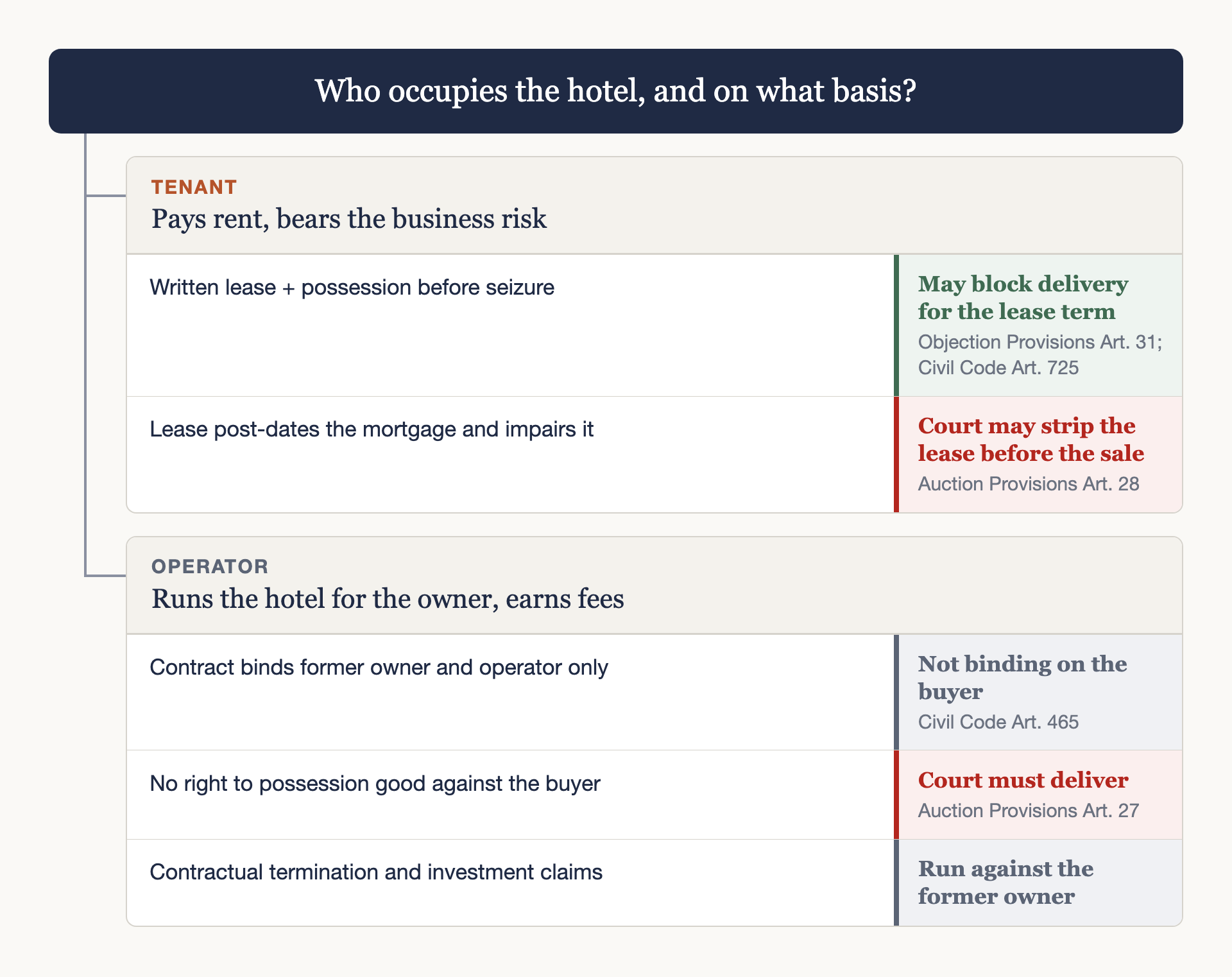
For a buyer, the commercial consequence is straightforward. The operator's contract is the former owner's liability, not an asset the buyer acquired and not a burden it assumed.
Why Civil Code Article 933 Belongs to the Former Owner's Dispute
Where a hotel management agreement is characterized as an entrustment contract, Civil Code Article 933 allows either party to terminate it at any time. A party who terminates a paid entrustment must compensate the other for its direct losses and for the benefits that performance would have produced. In a long-term hotel agreement, that second limb is what makes termination expensive.
That characterization is itself unsettled. Many Chinese courts and arbitral tribunals hear these disputes as entrustment cases. Others treat agreements that combine management, brand licensing, reservation systems and capital commitments as mixed or unnamed contracts under Civil Code Article 467, and some have refused to apply the free termination right where the relationship is not a pure entrustment. The honest position is that the answer depends on how the agreement is drafted and where it is heard.
American readers will recognize the underlying idea. U.S. courts have generally treated a hotel manager as the owner's agent, whose authority the owner has the power to revoke, leaving the manager to a claim in damages. PRC law reaches a similar place by statute, with more doubt at the edges.
None of this is the buyer's fight. Article 933 governs the relationship between the parties to the agreement, and the buyer is not one of them. Lawyers unfamiliar with enforcement often assume that the buyer steps into the former owner's shoes; in a judicial sale of real estate, it does not, unless it chooses to.
That choice can be made by accident. A buyer who sends the operator a notice terminating "the management agreement," then accepts revenue remittances and pays the operator's fees, invites the argument that it has adopted the arrangement by conduct, which Civil Code Article 140 allows a court to infer. I would be cautious about sending any termination notice at all. The first letter should demand delivery of possession to the new owner, with a copy to the enforcement court.
Weaker Than a Lease in Law, Harder to Remove in Practice
On paper, an operator is easier to remove than a protected tenant. A tenant with a prior lease can keep the buyer out for the rest of its term; an operator has nothing to set against the buyer's title. A common belief, voiced in the column by a character presented as an enforcement insider, is that courts clear tenants but not operators. As a statement of law that is the wrong way round, although as a description of practice it is close to accurate.
The divergence has little to do with contract law. A trading hotel carries guests in rooms, banquet deposits, long-stay residents, supplier accounts and staff on shift. Brand affiliation belongs to whichever party signed with the brand, usually the operator, and brand agreements commonly make a change of owner a trigger for consent or termination.
The approvals that let a hotel trade are not a single permit attached to the building. The public security license for the hotel trade and the food business license are issued to a named business for particular premises, after an inspection of those premises. Fire safety has two layers: the fire acceptance completed when the building was built stays with the building, while a public gathering place such as a hotel also needs a pre-opening fire safety inspection, which Article 15 of the PRC Fire Protection Law (2021 Amendment, effective April 29, 2021) allows either the developer or the business using the premises to apply for. How each approval responds to a change of operator depends on the approval and on local implementation.
Removing the operator therefore does not hand the buyer a hotel. It hands the buyer a building whose next operator may need new, amended or reissued approvals, and a new brand if it wants one, before the hotel can continue trading lawfully. Foreign investors frequently overestimate what a delivery order achieves in a business of this kind, because in most systems the order is the end of the problem rather than the start of a transition.
Enforcement courts understand this. Their duty under Article 27 and the 2024 Guiding Opinions is real, but the timing and method of delivery leave room for judgment. In my experience, a court asked to remove an operator from a hotel with guests in residence and staff on the payroll will first ask whether the parties can agree a handover date. That is not the court abandoning its duty; it is the court choosing the method least likely to create new disputes, and it moves the cost of delay onto the party least able to bear it.
That party is usually the buyer. The price is paid, and the asset loses value every week it does not trade.
The operator's best legal argument, when it has one, is recharacterization. Characterization turns on the parties' rights and obligations taken as a whole: who possesses and controls the premises, who bears the operating risk, how the money flows, and whether the supposed operator is really running the business for its own account. A fixed return to the owner, with the upside kept by the operator, is strong evidence in that direction, but it is not a test on its own.
The operator will run that argument as a non-party objection under Article 238 of the PRC Civil Procedure Law (2023 Amendment, effective January 1, 2024). Winning the label is not enough, because a recharacterized lease must still pass the seizure and mortgage tests described above. The 2024 Guiding Opinions tell courts to test claimed encumbrances against commercial common sense, and I would expect a court to look past labels in both directions. Even a weak objection buys the operator time.
Put together, a management agreement is weaker than a lease against the buyer's title and stronger than a lease against the buyer's timetable.
Who Actually Owes the Operator's Claims
In the column's account, the operator's demand bundled three items: unamortized renovation spending, severance and social insurance for the staff, and penalties on forward bookings. Each is a genuine liability of someone. None, on its face, is a liability of the buyer. The first useful step is to sort them by legal character rather than by amount.
Contractual claims stay between the contracting parties. The renovation spending was approved under the operator's agreement with the former owner, and forward bookings are contracts between guests and the business that took the booking and the money. The buyer signed neither.
Property and restitution claims are the ones most likely to be pleaded against the buyer directly. Civil Code Article 322 decides who owns improvements that have merged into a building and allows compensation where that allocation harms a party, and an operator may also try unjust enrichment under Article 985 against the new owner. I would be cautious about treating either route as strong against an auction buyer, who paid a court-supervised price for the building as improved. The point is not settled, however, and a preservation order sought on the claim can hurt even if the claim later fails.
Employment liability follows the employer, which is the operator or the former owner. Articles 33 and 34 of the PRC Labor Contract Law (2012 Amendment, effective July 1, 2013) carry employment contracts through a change of the employer's name, investors, merger or division, and a purchase of real estate at auction is none of these. The position can change if the buyer re-employs the staff, because Article 10 of the Regulations for the Implementation of the PRC Labor Contract Law (effective September 18, 2008) counts prior service where an employee is moved to a new employer for reasons not of the employee's own making, unless severance for that service has already been paid. Either way, the practical pressure from labor authorities and from a court wary of mass dismissals moves toward whoever has the money and wants the hotel open.
The regulatory consequences of changing the operator are not claims at all. They add cost and delay for whoever wants the hotel to keep trading.
Why, then, does the bill arrive at the buyer's door? The former owner is a judgment debtor whose principal asset has just been sold to pay someone else, so a claim against it is worth little. The buyer is the only solvent party with a reason to keep the hotel trading, and it is that reason, not any legal liability, that the operator is pricing.
The table keeps legal liability and negotiating exposure apart. A buyer who blurs the two ends up negotiating against the wrong number.
| Legal character | Item | Who is legally bound | Negotiating exposure |
|---|---|---|---|
| Contractual | Management agreement termination compensation | Former owner and operator (Civil Code Art. 465) | The operator stays in occupation until delivery is agreed or enforced |
| Contractual | Approved renovation spending | Former owner, under the contract that approved the work | The former owner is a judgment debtor, so the claim is worth little against it |
| Property / restitution | Improvements merged into the building (Civil Code Arts. 322, 985) | Unsettled, and a weak route against an auction buyer | Can still support a preservation order |
| Employment | Staff severance and social insurance | The employer: the operator or the former owner | Re-employing staff invites service-year claims; authorities look to the party able to keep people employed |
| Contractual | Forward bookings and deposits | The business that took the booking and the money | Cancellations generate complaints that slow delivery |
| Contractual | Brand affiliation | Whichever party signed with the brand, usually the operator | Brand agreements commonly require consent to a change of owner |
| Regulatory | Operating approvals | Issued to a named business for particular premises | A change of operator may require new, amended or reissued approvals |
The planning point. Diligence on a hotel auction should start where the auction announcement stops. Article 13 of the Provisions of the Supreme People's Court on Several Issues concerning Online Judicial Auctions by People's Courts (effective January 1, 2017) requires the court to publish the property's ownership, possession, use and attached obligations, and the 2024 Guiding Opinions bar courts from using an "as is" sale to skip that investigation. In my experience, announcements still rarely reproduce the management agreement, the brand agreement or the payroll. A bidder should obtain them, from the operator if necessary, and price an orderly transition before setting a bid. How that diligence is usually organized is covered on the Asset Management, Restructuring & Distressed Assets practice page.
Practitioner's Note
What decides these cases is timing. Before the auction closes, the buyer holds the one option that matters, which is not to bid, and an operator facing an insolvent owner often wants a creditworthy counterparty as much as the buyer wants continuity. Once the ruling is served, that option is gone, the price is paid, and each week without a handover costs the buyer more than it costs the operator.
The buyers who do well treat the auction as the second step of a transaction rather than the first. They agree a transition, or a renegotiated management agreement, while the operator still needs them, and they bid knowing what the hotel will cost as distinct from the building.
A court can give a buyer title and, in time, vacant possession. Only a negotiation conducted before the bid gives it a hotel.
Legal Authorities
- PRC Civil Code (effective January 1, 2021), Articles 140, 322, 465, 467, 725, 933 and 985
- PRC Civil Procedure Law (2023 Amendment, effective January 1, 2024), Article 238
- PRC Labor Contract Law (2012 Amendment, effective July 1, 2013), Articles 33 and 34
- Regulations for the Implementation of the PRC Labor Contract Law (effective September 18, 2008), Article 10
- PRC Fire Protection Law (2021 Amendment, effective April 29, 2021), Article 15
- Provisions of the Supreme People's Court on Auction and Sale of Property in Civil Enforcement by People's Courts (2020 Amendment, effective January 1, 2021), Articles 26, 27 and 28
- Provisions of the Supreme People's Court on Several Issues concerning Online Judicial Auctions by People's Courts (effective January 1, 2017), Article 13
- Provisions of the Supreme People's Court on Several Issues concerning the Handling of Enforcement Objection and Reconsideration Cases by People's Courts (2020 Amendment, effective January 1, 2021), Article 31
- Guiding Opinions of the Supreme People's Court on Further Regulating Online Judicial Auctions (Fa [2024] No. 238, issued October 29, 2024), Items 1, 2 and 8
This article provides general information on PRC law as of the last reviewed date below. It is not legal advice and should not be relied on for any specific transaction or dispute.
Last reviewed: September 11, 2026.
Related Legal Analysis
- The Hidden Sentence in the Petition Was Not Written for the Judge
Commercial DisputesAnalysis18 min read
- Your Chinese Supplier Will Show You Anything. Ask It to Agree to Something Instead.
Commercial DisputesAnalysis15 min read
- I Took a Korean Buyer to the Address of His Precious Metals Seller. It Was Now a Pharmacy.
Commercial DisputesAnalysis25 min read
Related Practice Areas
If your business is facing similar issues, please contact me to discuss how I may assist.