A Lawyer Helped His Client Open a Bank Account. It Cost Him His License and Nine Months in Prison.
Why China's crime of refusing to enforce a court judgment now reaches the debtor's own lawyer — and how a 2024 interpretation makes it easier to prove.
PRC law position reviewed as of .
A company owed money it could not pay. A court had frozen its bank accounts.
In an unrelated case, one nobody at the enforcing court was watching, another company owed that same debtor money — and a payment was about to land.
The debtor's own lawyer helped make sure the enforcing court would never see it.
He was convicted of a crime for that help, sentenced to nine months in prison, and stripped of his license to practice.
This is not really a story about one under-capitalized construction contractor. It is a story about where Chinese law now draws the line between defending a client who cannot pay, and becoming a criminal participant in making sure the client never has to.
The case was reported through a criminal-risk circular the Nanjing Lawyers Association reportedly issued to its members. It answers one question with growing practical significance for anyone dealing with a Chinese counterparty that owes money: when does a lawyer's help to a judgment debtor cross from professional representation into accomplice liability for the crime of refusing to enforce a judgment?
At a Glance
| Authority | What It Establishes |
|---|---|
| Criminal Law of the PRC, Art. 313 (as amended by Criminal Law Amendment (IX), effective Nov. 1, 2015) | Defines the crime of refusing to enforce a judgment or ruling: up to three years' imprisonment where circumstances are serious, three to seven years plus a fine where especially serious; units may be liable, with responsible individuals separately punished |
| SPC Provisions on Several Issues Concerning Property Investigation in Civil Enforcement (2017, as amended 2020), Arts. 1, 5, 9 | Requires a judgment debtor to truthfully report its property, including claims and other proprietary rights held against third parties; non-disclosure risks fines, detention, or criminal referral |
| SPC/SPP 2024 Interpretation on Handling Criminal Cases of Refusing to Enforce Judgments or Rulings, Art. 8 (effective Dec. 1, 2024) | Extends liability to any third party who knowingly conspires with the debtor and assists in concealing or transferring property — as an accomplice to the same offense |
A Receivable in the Wrong File
The debtor here was, in one proceeding, exactly what its frozen accounts suggested: a company that owed money on a construction contract and could not pay. In a separate, unconnected proceeding, the same company sat on the other side of the table — a different court had already ordered a third party to pay it.
Nothing in Chinese civil procedure links unrelated case files sitting in different courts. The enforcing court would learn about the incoming payment only if the debtor reported it.
It did not. The debtor and its lawyer arranged for the payment to land in a newly opened account at a different bank, beyond the freeze order's reach, and the lawyer personally helped open it. Part of the funds went to the law firm's own account; the rest moved through several more transfers before reaching the company's controller personally. None of it satisfied the judgment.
The Duty That Made the Concealment a Crime
Two bodies of PRC law converge on this fact pattern, and both matter to understanding why the outcome was not simply a defense strategy that went wrong.
The first is the debtor's own reporting obligation. Under the Supreme People's Court's Provisions on Several Issues Concerning Property Investigation in Civil Enforcement, a judgment debtor must truthfully report its property to the enforcing court, and the reportable categories explicitly include claims and other proprietary rights held against third parties — not only cash and bank deposits. A receivable the debtor is separately pursuing as a claimant in another case falls squarely within that duty.
In my experience, the mistake is an understandable one, not a careless one. Litigation files are managed case by case, and a lawyer retained for one enforcement matter naturally treats a receivable sitting in a different courtroom as somebody else's file. The 2017 Provisions do not see it that way: the debtor's duty to report follows the debtor itself across every proceeding it is party to, not the particular case a given lawyer happens to be instructed on. Once another court establishes the debtor's entitlement to the receivable, the receivable becomes property the debtor must report in enforcement proceedings — long before any money actually changes hands. Non-disclosure starts as a civil problem. It becomes a criminal one the moment it looks like what happened here.
That criminal liability sits in Article 313 of the Criminal Law: a person able to comply with an effective judgment or ruling who refuses to do so, where circumstances are serious, faces up to three years' imprisonment, criminal detention, or a fine; where circumstances are especially serious, three to seven years plus a fine. Companies can be held liable as units, with the individuals directly responsible separately punished.
Where the Lawyer Stopped Being a Bystander
For years, the working assumption among defense-side enforcement lawyers was that Article 313 was the debtor's problem, not theirs. A 2024 interpretation jointly issued by the Supreme People's Court and the Supreme People's Procuratorate closed that gap. Effective December 1, 2024, it provides that a third party who knows the person obligated to comply has the ability to do so but refuses, who conspires with that person, and who assists in concealing or transferring property, is criminally liable as an accomplice to the same offense — regardless of whether that third party ends up keeping any of the money.
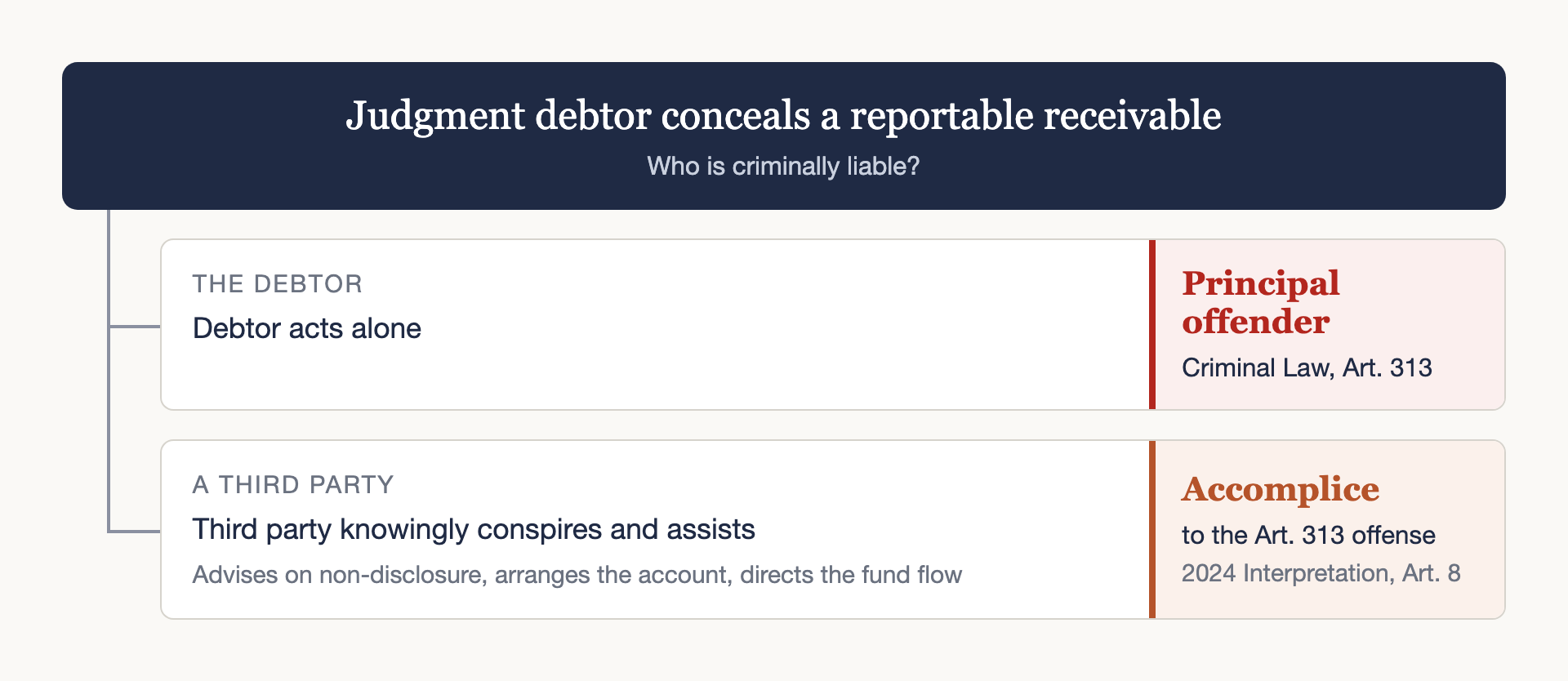
Lawyers are not named in the provision, but nothing exempts them. In the case reported here, the lawyer's own conduct — aware that the judgment was fully enforceable, aware the receivable existed, and aware that concealing it would defeat the freeze — supplied both elements the provision requires: knowledge, and assistance.
Where Practice Diverges From the Statute Book
Most of what defense-side enforcement lawyers do is exactly what it should be: raising legitimate procedural objections, negotiating settlement, contesting the valuation of seized assets, testing the sufficiency of the creditor's evidence. None of that creates the risk described here, and nothing in the 2024 Interpretation suggests otherwise.
In practice, these situations rarely begin with an instruction to conceal assets. They usually begin with a client asking whether an incoming payment can be used to keep the business running until a settlement is reached. By the time the conversation turns to which account should receive the money, the question has quietly stopped being a legal one and become a criminal one.
What changes the analysis is participation in the mechanics of concealment rather than in the client's legal position. Advising a client on how to argue a case is representation; helping a client decide what a court will never be told, or which bank an incoming payment should land in, is something else entirely.
Lawyers who cross this line rarely think of themselves as doing more than solving a difficult client's cash-flow problem — which is exactly how the conversation started. The Interpretation does not ask what the lawyer believed he was doing. It asks whether he knew the client could pay, knew the client would not, and knowingly helped anyway — and Chinese enforcement proceedings are unusually well-documented environments in which to prove exactly that. Account-opening records, bank transaction records, correspondence between lawyer and client, and the client's own eventual account of events, once asked where the money went, together tend to leave little room for an "I was only providing routine representation" defense. That combination is what defeated it here.
What I tell clients: the moment a conversation shifts from what the law allows to what the court will never find out, it is time for another lawyer to look at the file.
Foreign creditors dealing with a distressed PRC counterparty often assume the lawyer on the other side is, whatever else is true, at least an adversary operating inside the rules. That assumption is usually correct, but it is worth testing rather than taking for granted whenever a debtor's receivables seem to disappear faster than the enforcing court can trace them — particularly where the debtor is, in some unrelated matter, also a claimant. A second, unconnected case is a recurring vector for exactly this kind of concealment, precisely because nothing forces the two files to speak to each other. This is where lawful distressed-asset recovery tools — a court-ordered investigation order, a request for bank transaction records, and, where the evidence supports it, a criminal referral — do the work that confronting opposing counsel directly cannot.
What International Advisers Get Wrong
Foreign counsel advising on a Chinese dispute often carry over an assumption that does not travel: that a lawyer representing a debtor is insulated by the act of representation itself, and that whatever happens to the client, the lawyer's own exposure stays professional rather than criminal. PRC criminal law offers no comparable protection merely because the conduct occurred during legal representation. The 2024 Interpretation does not ask whether the lawyer was doing legal work when he helped open the account; it asks what he did and what he knew. Assuming the other side's lawyer is someone you can only out-argue in court, never someone whose own conduct might unravel the case, is exactly the risk this case illustrates.
Divided Incentives
Once the scheme unraveled, the debtor had every reason to call it the lawyer's idea; the lawyer was left holding a modest fee against a criminal record and a career that does not come back.
He did not lose his license because he opened a bank account. He lost it the moment he stopped advising his client what the law required and started managing, on the client's behalf, what the court would never be told.
Key Takeaways
- China's crime of refusing to enforce a judgment (Criminal Law Art. 313) is no longer confined to the judgment debtor: a third party who knowingly conspires with the debtor and helps conceal or move property is liable as an accomplice under a 2024 judicial interpretation.
- Judgment debtors must affirmatively report receivables and other proprietary rights to the enforcing court, including claims pursued in unrelated proceedings — silence is not a defense.
- Legitimate enforcement defense (objections, settlement negotiation, evidentiary challenges) carries none of this risk; assisting with the mechanics of concealment does.
- Creditors who see a debtor's receivables vanish faster than they can be traced should treat that as a signal to pursue lawful discovery, not a dead end.
Frequently Asked Questions
Can a lawyer really be prosecuted for helping a client the lawyer was hired to represent? Not for representation itself. The exposure attaches to knowingly conspiring with the client and assisting in concealing or transferring property that should have been disclosed — conduct distinct from advocacy.
Does the lawyer have to keep some of the concealed money to be liable? No. Accomplice liability under the 2024 Interpretation turns on knowing conspiracy and assistance, not on sharing in the proceeds. In the case discussed here, part of the funds did move through the lawyer's own firm account, but that was evidence of involvement, not a legal precondition for it.
What should a creditor do if it suspects the debtor's lawyer is helping conceal assets? Pursue it through the court rather than informally. A lawyer investigation order or a court-ordered request for bank records can establish the fund flow; where the evidence supports it, the matter can be referred for criminal investigation. Confronting opposing counsel directly rarely accomplishes more than warning them to stop.
This article discusses matters of Chinese law based on publicly reported information. It is provided for general informational purposes only and does not constitute legal advice, and reading it does not create an attorney-client relationship. Readers facing a similar situation should seek advice from qualified PRC counsel based on their specific facts.
Legal Authorities
- Criminal Law of the People's Republic of China, Article 313 (as amended by Criminal Law Amendment (IX), effective November 1, 2015)
- Provisions of the Supreme People's Court on Several Issues Concerning Property Investigation in Civil Enforcement (Fa Shi [2017] No. 8, as amended 2020), Articles 1, 5, 9
- Interpretation of the Supreme People's Court and the Supreme People's Procuratorate on Several Issues Concerning the Application of Law in Handling Criminal Cases of Refusing to Enforce Judgments or Rulings (Fa Shi [2024] No. 13), effective December 1, 2024, Article 8
Last Reviewed: July 26, 2026
Related Legal Analysis
- You Gave the Assets Away. China Just Said That Is Not the Test.
Foreign InvestmentAnalysis12 min read
- Private Equity Fund Risk Resolution and Manager Continuity: A Practical Legal Framework
Distressed AssetsAnalysis30 min read
- When a Signed Settlement Is Not Enough: Judicial Confirmation of High-Value Cash Loans under PRC Law
Commercial DisputesAnalysis13 min read
Related Practice Areas
If your business is facing similar issues, please contact me to discuss how I may assist.