You Gave the Assets Away. China Just Said That Is Not the Test.
China's new offshore trust individual income tax rules charge the person who funded the property, bears its cost and controls it — not the person named on the trust deed.
PRC law position reviewed as of .
On a Friday afternoon in July, two ministries published a short document about offshore trusts.
It did not create a new tax.
It answered a question that Chinese tax law had left to inference for years: when property sits inside an offshore trust, whose income is it?
The answer is not the one written in the trust deed.
Why this is not a private wealth story
Most commentary has treated the announcement as a matter for a few hundred very rich families. That reading is too narrow.
The announcement resolves the ownership question by asking three factual questions: who funded the property, who bears its cost, and who controls it. That test does not stop at family trusts. It describes the ordinary architecture of offshore holding vehicles, nominee shareholdings, red-chip structures and employee incentive platforms used across cross-border business involving China.
So the question this article answers is narrow, and it is not really about trusts: when will the PRC tax authorities disregard who legally owns offshore property and tax the Chinese resident standing behind it?
Three moments, one taxpayer
The charging provisions are not new. Residents of China are taxed on worldwide income under Article 1 of the Individual Income Tax Law of the People's Republic of China (2018 Amendment, effective January 1, 2019). Income from the transfer of property, and interest, dividend and bonus income, are both taxed at 20% under Articles 2 and 3.
What the announcement supplies is timing and characterization. It divides the life of a trust into three moments and tells you which category applies at each.
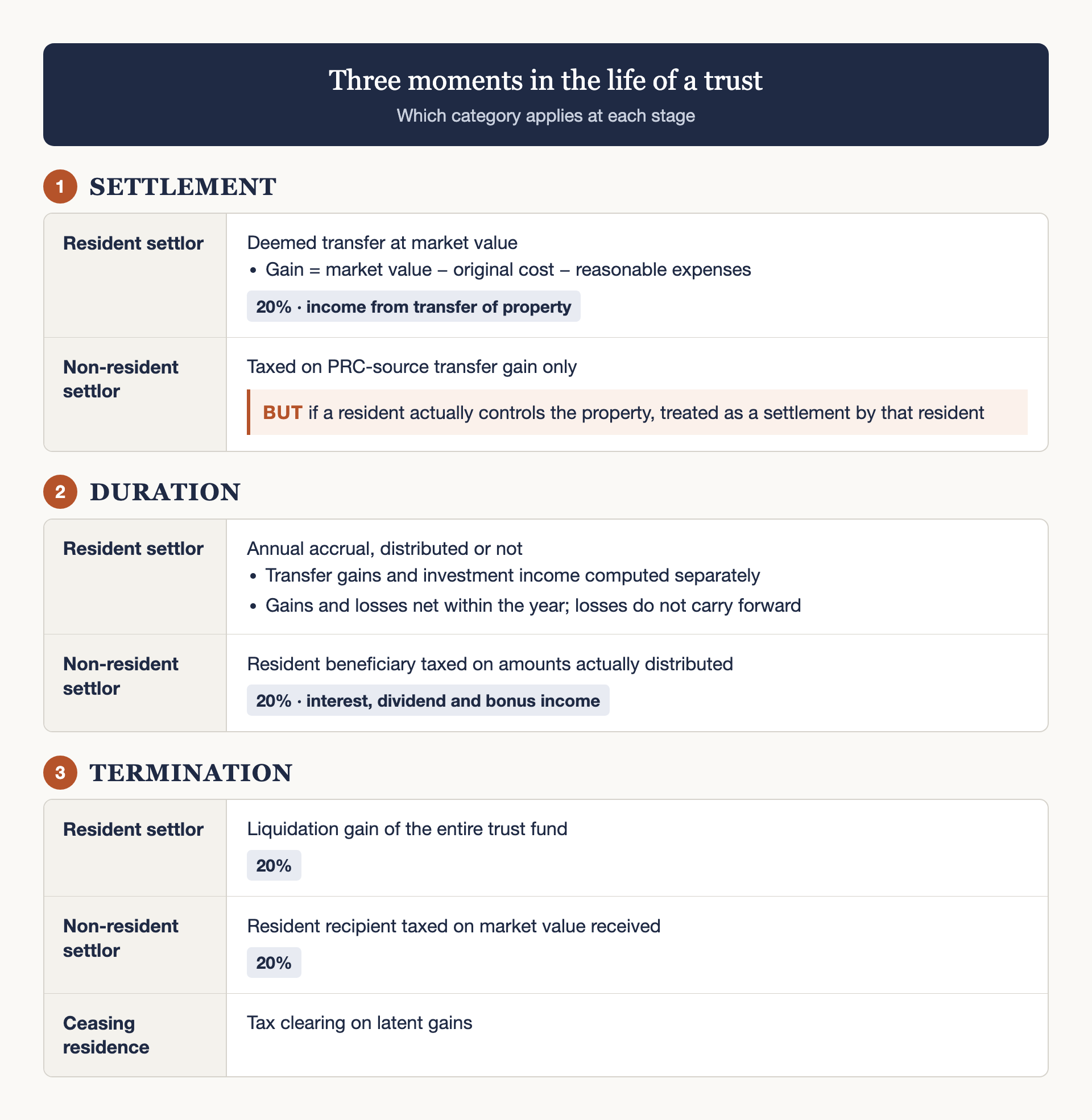
Two features of this framework are protective, and both have been widely misreported.
First, income that has already borne Chinese tax at the accrual stage is not taxed again when it is actually distributed. The structure is annual accrual followed by exempt distribution, not a toll charge at every gate.
Second, individual income tax paid abroad in connection with the trust is creditable under Article 7. The commentary suggesting that the same money is taxed three times over, with no relief for foreign tax, is wrong on both counts.
The planning point: the rate is fixed and the reliefs are ordinary. Everything that matters happens in the definition of the taxpayer.
Where the announcement stops asking who owns the property
The anti-avoidance provisions are the heart of the document. They operate on a substance-over-form basis, and they close the four routes offshore structuring has historically relied on.
At settlement, property contributed through another individual or entity is treated as contributed by the person who funded it, bore its cost, or controls it. A nominee is not a shield; the nominee is not even the taxpayer.
During the trust's life, undistributed income counts. So does income parked in offshore entities the individual controls. The traditional answer to an accrual charge — leave the money inside and distribute nothing — no longer defers anything.
On termination, an individual who ceases to be a Chinese tax resident faces a clearing computation on latent gains. Emigration does not defer the charge. It accelerates it.
And an individual who has moved abroad, including one who has acquired foreign nationality or long-term residence rights, may still be determined to be a Chinese tax resident where their principal economic interests remain in China.
Why the ownership question stopped working
It is worth asking why this clarification arrives now, because the answer explains more about the risk than the drafting does.
Nothing in the underlying charge has changed. Residents have always been taxable on worldwide income, and the general anti-avoidance rule in Article 8 has been available since 2019. What made offshore trusts effective was never a strong legal argument that the settlor had genuinely parted with the property. It was that the tax authority could not see the structure, could not value what went into it, and had no practical way to test who was really directing it.
That informational gap has closed. Automatic exchange of financial account information now delivers, as a matter of routine, the account balances, distributions and controlling-person details these arrangements depended on nobody having. Once the administration can see the structure, the substance-over-form principle it always possessed becomes usable — which is why the announcement reaches structures that have sat quietly for years.
An adviser who assesses an offshore arrangement by asking who holds legal title is therefore answering a question the tax authority has stopped asking. The relevant questions are now evidential: who paid for the assets, who has practical influence over distributions, and what a tax officer would conclude from the documents if they read the file cold.
In my experience the structures most exposed are not the aggressive ones. Aggressive structures were built by people who expected scrutiny and documented them with that in mind. The exposure sits in ordinary arrangements set up years ago on standard forms that nobody ever expected anyone to examine.
What I tell clients: the structure you can explain is worth more than the structure that hides you, and that has not been true for very long.
Valuation is where these cases are lost
Twenty percent is a number anyone can plan around. The difficulty lies one layer down, in the base.
Settlement is taxed on market value less original cost and reasonable expenses. For listed shares that computation is mechanical. For unlisted equity in a private operating company it is not, and the tax authorities have long-standing power to assess a transfer price they consider understated. The Administrative Measures for Individual Income Tax on Income from Equity Transfers (Trial), State Taxation Administration Announcement No. 67 of 2014, effective January 1, 2015, sets out both the grounds for assessment and the permitted methods, including net asset valuation.
In my experience, valuation disputes consume more time, and more of the client's money, than any argument about the charging provision. By the time the discussion has become a debate about net-asset methodology, the argument about whether tax is chargeable has already been lost: the taxpayer is arguing about the size of a liability, not its existence.
What decides those arguments is a contemporaneous file — audited accounts for the year of the transfer, a valuation prepared at the time rather than reconstructed afterwards, and evidence of what the shares originally cost. Rebuilding that record five years later, for a company that has since restructured, changed auditors or brought in new investors, is the point at which clients discover the true price of the original planning.
The word "reasonable" is doing quiet work too. The announcement permits a deduction for reasonable expenses at settlement, but does not say whether recurring trustee, administration and professional fees over the life of the trust qualify. I would be cautious about assuming they do until this is addressed. That is an open question today and should be treated as one.
There is a further asymmetry worth noticing. Gains and losses net within a single year, but losses cannot be carried forward. A trust holding volatile assets can therefore pay tax across a period in which it made nothing overall.
Ninety days is not an amnesty
The transitional rules have been read as a grace period. That reading misunderstands what is being waived.
Unpaid settlement-stage tax is recoverable in principle for three years, reaching back to property contributed from January 1, 2023, with the tax authorities able to extend that period where the amounts are large. Income from 2025 and earlier years that was never taxed at the distribution stage is computed on a packaged basis and reported as interest, dividend and bonus income. Payment falls due within ninety days of the announcement taking effect.
The three-year figure is not a concession invented for this announcement. It is the ordinary recovery period in Article 52 of the Law of the People's Republic of China on the Administration of Tax Collection (2015 Amendment), which extends to five years in the special circumstances defined by Article 82 of its Implementing Rules, and which does not apply at all to tax evasion. What the ninety-day window waives is the late payment surcharge under Article 32, running at 0.05% per day — a little over 18% annualized, which is not trivial.
Lawyers unfamiliar with PRC tax administration read this as the government pricing an amnesty. The surcharge is the smaller exposure. The real question a taxpayer answers by coming forward inside the window is whether the historic non-reporting is later characterized as an error or as evasion — and if it is characterized as evasion, no limitation period protects them at all.
What a foreign passport does not do
Foreign investors, and Chinese founders who have taken foreign nationality, routinely assume that a second passport ends Chinese tax residence.
It does not. Depending on the facts, it may not weaken it at all.
Under Article 1 of the Individual Income Tax Law, an individual is a Chinese resident either by spending 183 days in China in a tax year or by being domiciled in China. Domicile is defined in Article 2 of the Implementing Regulations as habitual residence in China by reason of household registration, family or economic interests.
That is a ties test, not a calendar. It has always been in the law, and has simply been applied lightly.
Read against that background, the announcement's statement about individuals who have emigrated but whose principal economic interests remain in China is not a new residence rule. It is a signal that an existing one is going to be enforced.
The distinction cuts both ways. The announcement determines nobody's residence: whether an individual remains domiciled in China is a question of fact under the Individual Income Tax Law and its Implementing Regulations, decided case by case on household registration, family and economic ties. A taxpayer who has genuinely moved their family, their home and their economic centre of gravity has an argument. A founder who has taken a foreign passport while the operating business, the family and the income all remain in China has, in my view, considerably less of one than he believes.
Practitioner's Note
None of this will be decided by the rate, and very little of it will be decided by the trust deed.
It will be decided by documents. A taxpayer facing a settlement-stage assessment needs a defensible valuation of what went into the structure, evidence of what it originally cost, and records of foreign tax paid. Structures deliberately built to be opaque are now the hardest to defend, because opacity was the point and the taxpayer carries the evidential burden.
There is an irony in that. Offshore trusts were sold on the premise that legal separation is what matters: the settlor gives the property away, and the paperwork records that he no longer owns it. Chinese tax law has now said, as clearly as it ever has, that separation on paper is not separation in substance where the same person still funds, benefits from and controls the assets.
The strongest offshore structure is no longer the one that creates the greatest legal distance. It is the one whose economic reality can still be proved ten years later, from a file someone had the discipline to keep.
Frequently asked questions
I transferred everything into the trust years ago. Can China still tax me?
Partly, and the two stages differ. The settlement charge carries a recovery period, running in principle for three years and reaching back to January 1, 2023, extendable where the amounts are large. Income arising during the trust's life is not limited in the same way: it is reportable regardless of when the trust was established. An older trust is therefore not outside the rules — only the one-off settlement charge is time-limited.
Does taking a foreign passport end my exposure?
No. Chinese tax residence turns on domicile as well as day count, and domicile is a factual test based on household registration, family and economic ties. Separately, ceasing to be a Chinese resident triggers a clearing computation on latent gains rather than deferring anything.
Is a fully discretionary trust with an independent professional trustee outside these rules?
Not automatically. The test looks to who funded the property, who bears its cost and who controls it in substance. Where a settlor retains practical influence over distributions — through a letter of wishes given real weight, a reserved power, or a protector who follows instructions — a formal transfer of legal title to a professional trustee should not be assumed to end the analysis.
Legal authorities
- Individual Income Tax Law of the People's Republic of China (2018 Amendment, effective January 1, 2019), Articles 1, 2, 3, 7 and 8
- Implementing Regulations of the Individual Income Tax Law of the People's Republic of China (2018 Revision, effective January 1, 2019), Article 2
- Law of the People's Republic of China on the Administration of Tax Collection (2015 Amendment), Articles 32 and 52
- Implementing Rules for the Law on the Administration of Tax Collection, Article 82
- Administrative Measures for Individual Income Tax on Income from Equity Transfers (Trial), State Taxation Administration Announcement No. 67 of 2014, effective January 1, 2015
- Announcement on Matters Relating to the Levy of Individual Income Tax on Offshore Trusts, Ministry of Finance and State Taxation Administration, issued July 24, 2026
This article discusses general principles of PRC law and does not constitute legal advice on any specific matter.
Last Reviewed: July 24, 2026
Related Legal Analysis
- He Sold Control of a Listed Company for 1.29 Billion Yuan — At Exactly 29.99%, Not 30%
Corporate TransactionsAnalysis8 min read
- What Happens to Your Chinese Company When Its Actual Controller Dies
Distressed AssetsAnalysis11 min read
- Private Equity Fund Risk Resolution and Manager Continuity: A Practical Legal Framework
Distressed AssetsAnalysis30 min read
Related Practice Areas
If your business is facing similar issues, please contact me to discuss how I may assist.