The Board Had the Votes to Remove the General Manager. Ten Missing Days Undid the Decision.
A Shanghai court revoked a board resolution removing a joint venture's general manager because the meeting notice was too short. Here is how PRC Company Law Article 26 polices board procedure — and why a joint-venture contract, on its own, may not protect you.
PRC law position reviewed as of .
A Shanghai court revoked a board resolution removing a joint venture's general manager because the meeting notice was too short. Here is how PRC Company Law Article 26 polices board procedure — and why a joint-venture contract, on its own, may not protect you.
| Question | Short answer |
|---|---|
| Can a board resolution be unwound over short meeting notice? | Yes. Under PRC Company Law Article 26, a resolution is revocable if the convening procedure violates law, administrative regulations, or the articles of association. |
| How long does a shareholder have to sue? | Sixty days from the date of the resolution. |
| Will the "minor defect" exception save the resolution? | Rarely, where the shortfall touches a contested removal. Courts protect the right to prepare and deliberate, not just the right to vote. |
| Does a joint-venture contract count? | Article 26 polices the articles of association. Protections that live only in the contract generally sound in damages, not revocation. |
On September 17, 2025, a Shanghai joint venture sent its directors notice of a board meeting.
Five days later, the board met and voted to remove the general manager.
The general manager was the minority shareholder's nominee. The joint-venture contract required fifteen days' notice.
Eight months later, a Shanghai court erased the vote.
This is not really a story about one steel-processing venture. It is the standard pattern in Chinese joint ventures: a majority shareholder with the votes, a minority shareholder with negotiated protections, and a removal fight in which procedure — not arithmetic — decides the first round.
So the question this article answers is a narrow one: when can a shareholder unwind a board resolution that the majority had every vote to pass?
What actually happened
The facts come from a public announcement by Friend Co., Ltd. (SSE: 605050), a Shanghai-listed steel supply-chain company (Announcement No. 2026-029, July 17, 2026).
In June 2022, Friend and Hunan Yigang Technology Co., Ltd. signed a joint-venture contract to establish Shanghai Fuliang Heavy Industry Materials Technology Co., Ltd., holding 55% and 45% respectively. The contract gave Hunan Yigang, the minority partner, the right to nominate the general manager, and required fifteen days' advance notice for board meetings.
By September 2025, the relationship had soured. Taking the position that the general manager had failed to perform his duties, the chairman proposed a board meeting to remove him. Notice went out on September 17; the meeting was held on September 22 — five days later, ten days short of the contractual requirement.
Hunan Yigang sued to revoke the resolution. On May 11, 2026, the Shanghai Baoshan District People's Court did exactly that, revoking the board resolution in case (2026) Hu 0113 Min Chu No. 6800. Fuliang has appealed to the Shanghai No. 2 Intermediate People's Court (case (2026) Hu 02 Min Zhong No. 8844); the appeal was heard on June 18, 2026 and remains pending, so the first-instance outcome may yet change.
One point of translation before the law. Chinese commentary on the case has described the removal decision as "invalid." The judgment did something more precise: it revoked the resolution. Under PRC company law, those are different doctrines with different consequences, and the difference is where the analysis has to start.
Three ways a Chinese board resolution dies
The PRC Company Law (2023 Revision, effective July 1, 2024) sorts defective resolutions of a shareholders' meeting or a board into three categories:
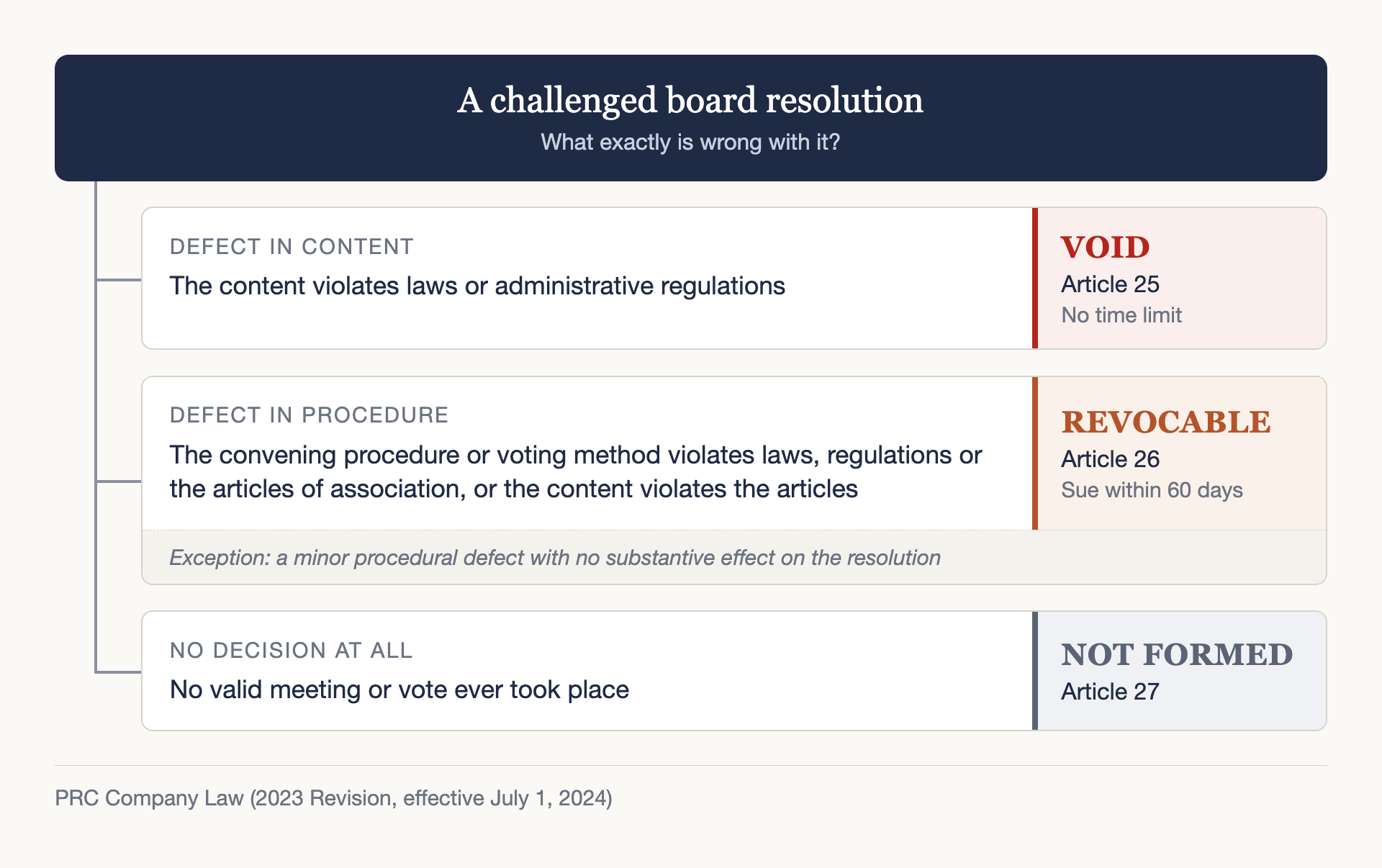
Short notice is the classic Article 26 case: the decision itself (removing a general manager) is perfectly lawful, but the way the meeting was convened broke the rules. Two features of Article 26 do most of the work in practice.
First, the sixty-day window runs from the date of the resolution and operates as a hard cutoff for shareholders who knew of the meeting. Miss it and the procedural defect is, for revocation purposes, cured.
Second, the law codifies an exception: where the convening procedure or voting method has only a minor defect with no substantive effect on the resolution, the court will not revoke. Majority shareholders read this exception optimistically. Courts do not.
Two more provisions frame the dispute. For a limited liability company, the Company Law leaves board deliberation and voting procedure largely to the articles of association (Article 73) — so a fifteen-day notice rule, once written into the company's constitutional documents, is exactly the kind of rule Article 26 enforces. And the general manager of a limited liability company is appointed and dismissed by the board (Article 74), which is why this fight ran through a board meeting at all.
Why "we had the votes anyway" fails
The majority's instinctive defense is causation: with 55% behind the removal, fifteen days' notice would have produced the same outcome, so the defect changed nothing.
In my experience, Chinese courts are consistently unpersuaded by this argument in contested removals, and the reasoning is worth understanding rather than memorizing. Notice periods do not exist to change vote counts. They exist so that every director can prepare, attend, object, and put opposition on the record — and so that shareholders behind those directors have time to react, negotiate, or seek relief before facts are created. A ten-day shortfall is not a typo in a meeting agenda; it compresses the very deliberation the rule protects. Courts therefore tend to reserve the minor-defect exception for genuinely trivial slips — a notice delivered a day late to a director who attended and voted without objection, a formatting defect in the convening documents — not for shortcuts taken against the interests of the party the procedure protects.
I would be cautious about relying on the minor-defect exception whenever the resolution strips a counterparty's negotiated protection, as the removal of a minority-nominated general manager plainly does. That is precisely the setting in which judges see the procedural rule as substantive.
There is also a timing question the announcement leaves open. The resolution was passed on September 22, 2025; the complaint was reportedly docketed in February 2026, well past sixty days. Public announcements compress procedural history — the point may have been contested, answered by an earlier filing, or simply not raised — and the pending appeal may address it. What the timeline usefully illustrates is how unforgiving the window is: a minority shareholder who wants to preserve the revocation remedy has to move within two months, not when negotiations break down.
The contract is not the constitution
Here is the issue I find international parties most consistently underestimate: Article 26 polices the articles of association — the registered constitutional document — not the joint-venture contract the parties actually negotiated.
The reported ground of challenge in this case was the fifteen-day notice requirement in the joint-venture contract. In well-drafted ventures the articles mirror the contract, and the distinction never surfaces. But the two documents diverge more often than they should. Foreign and domestic investors alike routinely negotiate a rich shareholders' or joint-venture agreement — nomination rights, notice periods, reserved matters — and then register boilerplate articles because the local registration authority prefers standard forms. Lawyers unfamiliar with PRC practice often assume the signed contract is the operative document, as it typically would be in a common-law shareholders' arrangement.
Under the Company Law, the articles bind the company, its shareholders, directors, supervisors, and senior management (Article 5). A governance protection that exists only in the contract generally gives you a claim for breach of contract against your counterparty — damages, perhaps specific performance — but not the Article 26 remedy of unwinding the corporate act itself. Revocation is the remedy with teeth: it restores the removed manager and forces the majority to start over. The practical rule I give clients is short: any governance protection you negotiated hard for belongs in the registered articles, verbatim, or you have negotiated a damages claim rather than a control right.
What revocation actually buys the minority
Be clear-eyed about the endgame. Revoking the resolution restores the general manager; it does not repeal the board's power to remove him. Nothing stops the majority from re-issuing notice — fifteen days this time — and passing the same resolution properly. If the majority controls the board, it usually wins the second round.
So why fight the first round at all? Because the interval is the point. A revocation judgment hands the minority months of restored management, a public finding that the majority breached the venture's own rules — an uncomfortable finding for a listed parent with disclosure obligations, as this case shows — and leverage to negotiate an exit, a buyout, or a governance reset before the properly-noticed meeting convenes. Foreign investors frequently overestimate what 55% buys on day one and underestimate what a procedural judgment buys the other side in month eight.
That is also the honest lesson of this case, whatever the appellate court decides. The statute supplied the remedy, but the outcome to date was determined by drafting and discipline: a notice period someone negotiated in 2022, a majority that treated it as a formality in 2025, and a minority that used it as the fulcrum it was always designed to be. Boardroom control in China is exercised through procedure, not despite it.
FAQ
Can the company simply hold the board meeting again with proper notice? Yes. Revocation eliminates the resolution, not the board's statutory power to appoint and dismiss the manager under Article 74. A properly convened meeting can adopt the same decision. The realistic function of the revocation suit is time and leverage, not permanence.
Does a shareholders' or joint-venture agreement bind the company itself in China? It binds the signing shareholders as a contract. But the machinery of the Company Law — including resolution challenges under Article 26 — runs on the registered articles of association. Mirror every negotiated governance protection into the articles.
How long do I have to challenge a defective board resolution? Sixty days from the date of the resolution, under Article 26. Treat it as a litigation deadline from day one, even while you negotiate.
This article is general commentary on PRC law based on publicly disclosed information. It is not legal advice, and no lawyer-client relationship is created by reading it. The appeal in the case discussed remains pending, and the first-instance judgment may be varied on appeal.
Authorities
- PRC Company Law (2023 Revision, effective July 1, 2024), Articles 5, 25, 26, 27, 73, 74
- Shanghai Baoshan District People's Court, Civil Judgment (2026) Hu 0113 Min Chu No. 6800 (May 11, 2026)
- Shanghai No. 2 Intermediate People's Court, appeal pending, (2026) Hu 02 Min Zhong No. 8844
- Friend Co., Ltd. (SSE: 605050), Announcement Regarding Litigation Involving a Controlled Subsidiary, No. 2026-029 (July 17, 2026)
Related Reading
- A Daughter Tried to Remove Her 83-Year-Old Mother From the Board. She Failed.
- When the Actual Controller of a PRC Company Dies
For how we structure governance protections in Sino-foreign ventures, see the Corporate & Commercial practice page.
Last Reviewed: July 22, 2026
Related Legal Analysis
- Every Investment Was Approved. More Than RMB 190 Billion Still Reached the Controlling Shareholder.
GovernanceAnalysis14 min read
- The Building Was in the Lot. The Hotel Was Not.
Distressed AssetsAnalysis15 min read
- The Hidden Sentence in the Petition Was Not Written for the Judge
Commercial DisputesAnalysis18 min read
Related Practice Areas
If your business is facing similar issues, please contact me to discuss how I may assist.