A Daughter Tried to Remove Her 83-Year-Old Mother From the Board. She Failed.
Removing a director in China takes a simple majority and no cause. The failed campaign at STAR Market-listed Allgens Medical (688613) shows why the statute is the easy part — and where board fights are actually decided.
PRC law position reviewed as of .
Here's what PRC company law actually teaches us about removing a director in China.
| Question | Short answer |
|---|---|
| Can shareholders remove a director mid-term? | Yes. An ordinary resolution is enough, no cause required, and removal takes effect the day of the vote. |
| Can the removed director get the seat back? | No. A director removed without legitimate reason can claim compensation from the company — not reinstatement. |
| Does that cover every board seat? | No. Employee-representative directors are elected and removed by the employee congress. Shareholders never vote on that seat. |
| Can I seat my own candidate instead? | Shareholders holding 1% or more may submit proposals ten days before the meeting — but board-size caps and agenda control stand in the way. |
| What actually decides the outcome? | Vote math locked in before the meeting opens. Public proxy solicitation rarely moves Chinese retail investors. |
A campaign that did everything by the book — and lost everything
An 83-year-old chairwoman.
Her daughter wanted her removed.
Her son-in-law wanted her seat.
The ones who lost did not lose because of the law.
It sounds like a family drama. It was actually a lesson in Chinese corporate governance.
In July 2026, Allgens Medical Technology Co., Ltd. (SSE STAR Market: 688613) published a sequence of announcements that, read together, amount to a field manual on how director-removal fights really work in China. The company's co-founder and joint actual controller, Mr Cui Fuzhai, had died in June 2025. Ms Huang Wanlan, born in 1943 and a director since 2020, inherited part of his shareholding and became chair of the board in November 2025. His daughter, Ms Helen Han Cui, and her husband, Mr Eric Gang Hu, holding 8.76% of the shares between them, decided the board had to change — and ran what was, on paper, a textbook activist campaign. An interim shareholder proposal to elect Mr Hu as a director. A public solicitation of proxy voting rights, setting out five governance and financial grounds for removal. A removal resolution put to an extraordinary general meeting.
Every step failed. The board declined to table the election proposal, because Article 116 of the articles of association fixed the board at nine members — three of them independent directors and one an employee representative — and all nine seats were validly filled for a term running to November 2028. The proxy solicitation, according to the legal opinion issued for the meeting by Shanghai Huiye Law Firm, gathered authorizations from exactly zero shareholders, representing zero shares and 0.00% of the voting stock. The removal resolution, put to the meeting on July 20, drew 40.3859% support against 59.3288% opposition. And in the middle of the campaign, the company's employee representative congress removed Ms Cui from her own seat as employee-representative director, effective July 10 — a seat no shareholder vote could protect.
The five grounds set out in the solicitation — on shareholder coordination, management expenses, an overseas acquisition, non-productive capital expenditure and litigation arising from internal control — are the campaigners' own disclosed assertions. They were contested, they were never adjudicated, and nothing in this article treats them as established. What follows is about the machinery, not the merits.
Nothing in the sequence was unlawful, and nothing in it worked. They lost long before the shareholders' meeting was called.
This is not really a story about one listed company. It is a story about what happens when succession, control and corporate governance collide — a collision that arrives, sooner or later, in almost every family-built Chinese company, and far more often than foreign investors realise.
This article answers one question: what does it actually take to remove — or defend — a director of a Chinese company?
Why the campaign failed
Strip away the filings and the answer is three sentences.
- The vote math was already settled. The incumbents controlled more shares than the insurgents, and the public appeal for proxies moved nobody.
- The board was full. Nine seats, nine sitting directors, a nine-seat cap in the articles — so the constructive half of the campaign never reached a vote.
- One of the insurgents' own seats didn't belong to the shareholders at all. It belonged to the employee congress, and the employee congress took it back.
None of this required bad faith, and none of it was improvised. Each obstacle was built into the company's legal architecture years before the fight began. To see how, you need three pieces of PRC company law.
Three ways to change a Chinese board
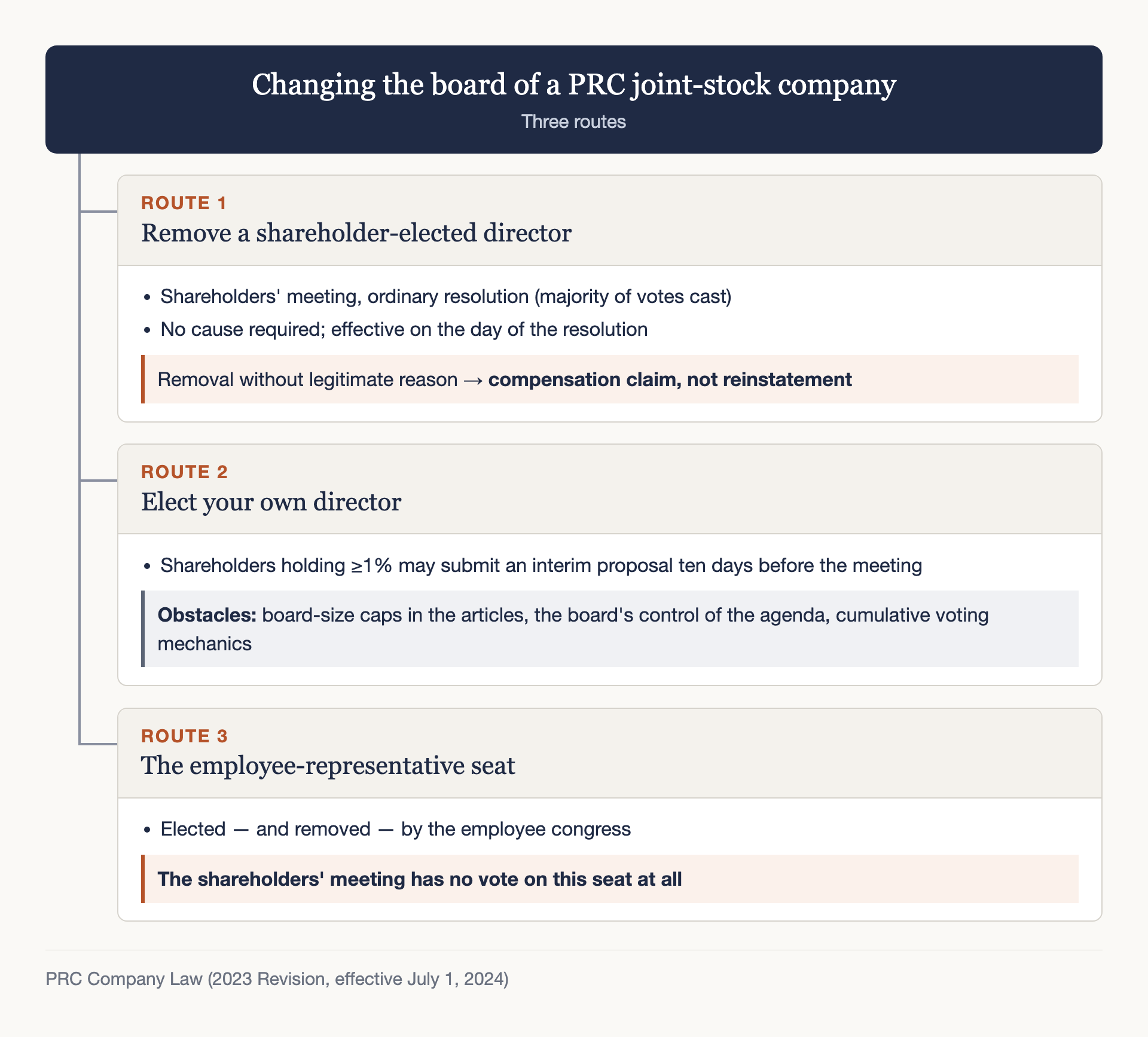
Route 1 is the headline rule. Under the PRC Company Law (2023 revision, effective July 1, 2024), Article 71, the shareholders' meeting may resolve to remove a director, and the removal takes effect the day the resolution passes. No cause is required. If the removal lacks a legitimate reason, the director's remedy is a compensation claim against the company — the seat itself is gone. Article 71 applies to joint-stock companies through Article 120. For readers from common law jurisdictions: there is no "for cause" standard to satisfy and no Delaware-style staggered-board defense to dismantle. The statute is more removal-friendly than most foreign investors expect.
Route 2 is the constructive alternative. Under Article 115, shareholders holding 1% or more — a threshold the 2023 revision lowered from 3% — may submit an interim proposal ten days before a shareholders' meeting. Electing your own candidate sounds gentler than removing someone else's. In practice it collides with the articles: if they fix the board at nine and nine are seated, there is no vacancy to fill, and the board will say so.
Route 3 is the one that gets missed. Lawyers unfamiliar with Chinese listed companies often assume the shareholders' meeting controls every seat at the table. It doesn't. Under Article 68, paragraph 1 (applied to joint-stock companies by Article 120), employee-representative directors are democratically elected by the employee representative congress or a similar body — and, by the same logic, removed by it. The nearest foreign analogue is German codetermination, but the Chinese version is narrower and sits entirely outside the shareholders' meeting. Shares do not vote on this seat, in either direction.
One more piece of machinery matters for listed companies. Under the PRC Securities Law (2019 revision), Article 90, proxy voting rights may be publicly solicited by the board, the independent directors, shareholders holding 1% or more, or statutory investor-protection institutions — free of charge and with disclosed solicitation documents. The tool exists. Whether it produces votes is a different question, and that is where law ends and practice begins.
Where removal campaigns actually fail
The math is settled before the meeting opens
The statute asks for a majority of votes cast. It says nothing about where those votes come from, and that silence is where campaigns die. The insurgents' 40.3859% and the incumbents' 59.3288% were, in all likelihood, both locked in before the meeting was convened. The solicitation — five reasoned grounds, formally disclosed, professionally papered — collected nothing at all: zero shareholders, zero shares.
Foreign investors frequently overestimate what a proxy solicitation can deliver in this market. China has no proxy-advisor infrastructure comparable to ISS or Glass Lewis, retail investors almost never sign authorizations for insurgents, and institutions tend to vote with incumbent management unless the facts are egregious. In my experience, a solicitation under Article 90 is best understood as a disclosure exercise and a signal of seriousness, not a vote-gathering machine.
Practical takeaway: count the locked-in votes before you file anything. If you cannot write down more than 50% of expected votes cast from named, committed holders, you are not running a removal campaign — you are sending a message, at the cost of showing your entire hand.
The board controls more of the procedure than the statute suggests
Article 115 gives a 1% shareholder the right to submit proposals. What it does not clearly settle is the board's role in screening them. Here, the proposal to elect Mr Hu reached the board on July 9; the board resolved not to submit it to the meeting and said so publicly two days later. Its stated reason was structural rather than political: Article 116 of the articles capped the board at nine, all nine incumbents were validly seated with no ground for removing any of them, and seating a tenth director would breach the cap.
The law on this point is genuinely unsettled, and it would be dishonest to present it otherwise. The mainstream position — reflected in stock exchange self-regulatory guidance — is that the board's review of shareholder proposals should be procedural, not substantive: it checks eligibility, timing, and legality, and lawful proposals go to the meeting. But boards in practice do refuse proposals on articles-based grounds, as this one did, and an articles-consistency objection sits awkwardly on the line between procedure and substance. A shareholder facing such a refusal has regulatory complaint and litigation routes; neither operates on a timeline that saves the current meeting.
The planning point: read the articles before you draft the proposal. A full board means removal must come before election — the two proposals have to be paired and sequenced, or the constructive half of your campaign will be screened out on day one.
The seat you hold can be taken while you attack — the most underweighted risk
Of everything in this case, the move that deserves the most attention got the least: one day after the election proposal reached the board, the employee representative congress resolved to remove Ms Cui from her employee-representative directorship, more than two years before her term was due to expire. She kept her executive role as technical director. The board seat was gone, and no shareholder vote was ever required.
I rank this the most underweighted risk in Chinese board contests, because it inverts the assumption that board seats are defended with shares. An employee-representative seat is not. It is held at the pleasure of the employee congress — a body that management, in practice, usually has considerable ability to convene and influence. A dissident holding one of these seats holds a position that cannot be defended by the votes they control, inside a structure their opponent effectively administers. The seat shareholders cannot vote on is also the seat shares cannot protect.
What I tell clients: treat an employee-representative directorship as borrowed, not owned. Never let a control strategy depend on a seat that a body you do not control can revoke — and if you are on the incumbent side, remember that this is one of the few pieces on the board that can be moved without calling a shareholders' meeting at all.
Practical protections
The deeper lesson is that this was never really about the removal vote. The dispute traces to a succession: Mr Cui's shareholding passed to his widow and his daughter separately, and — according to the campaigners' own disclosed reasoning — the acting-in-concert arrangement among the founding holders was never renewed with the daughter after the inheritance. The control structure changed in substance the day the founder died; the meeting thirteen months later merely recorded the consequences. I wrote separately about what founder mortality does to Chinese companies in What Happens to Your Chinese Company When Its Actual Controller Dies; this case is that article's governance chapter.
For those building toward a board challenge, the protections are contractual and arithmetical, not rhetorical. Voting commitments and acting-in-concert agreements should be in writing before anything becomes public, with attention to their term and to succession triggers — an agreement that lapses on a signatory's death is a time bomb in a founder-controlled company. I would be cautious about relying on informal family understandings in place of signed arrangements; this case shows exactly how those understandings end. Check whether the articles adopt cumulative voting (Company Law, Article 117), which can let a substantial minority seat a director even where it cannot remove one.
For incumbents and boards, the defensive levers sit mostly in the articles and the machinery: board size, proposal-handling procedures, the composition of the employee-representative structure, and control of convening and agendas — within the limits that listed-company governance rules place on entrenchment devices.
For a removed director, Article 71's compensation claim is real but modest. Courts commonly anchor the analysis to remuneration for the remaining term, and outcomes vary; what the claim never delivers is the seat.
Key takeaways
- Chinese law makes mid-term director removal easy on paper: a simple majority, no cause, effective immediately, with money damages as the director's only remedy.
- Removal fights are decided by vote math fixed before the meeting. Public proxy solicitation under Securities Law Article 90 is a disclosure tool; expecting it to gather decisive votes is, on current market practice, unrealistic.
- The board's power to screen shareholder proposals — especially against articles-based objections like board-size caps — is legally unsettled and practically significant. Pair and sequence removal and election proposals accordingly.
- Employee-representative directors sit outside the shareholder voting system entirely. That seat can be gained or lost without any shareholders' meeting, which makes it both a blind spot and a weapon.
- Most of these disputes are succession failures wearing governance clothing. The cheapest protection is a renewed acting-in-concert agreement signed while the founder is alive.
Frequently asked questions
Can shareholders remove a director in China without cause? Yes. Under Company Law Article 71, the shareholders' meeting may remove a director by ordinary resolution, effective the day the resolution passes. Cause is not required.
Can a removed director sue for reinstatement? No. If the removal lacked a legitimate reason, the director may claim compensation from the company. Reinstatement is not an available remedy.
Who can publicly solicit proxy votes for a Chinese listed company? Under Securities Law Article 90: the board of directors, the independent directors, shareholders holding 1% or more of voting shares, and statutory investor-protection institutions. Solicitation must be free of charge and supported by disclosed solicitation documents.
Boardroom battles are rarely won in the meeting room. They are usually won years earlier — in shareholders' agreements, articles of association and control arrangements. By the time a removal resolution reaches a vote, the outcome is mostly a matter of record-keeping. That is where I would spend the legal budget.
This article analyses a matter that the company and its shareholders disclosed publicly, and relies only on those disclosures. I act for no party to it and have no view on the underlying commercial allegations, none of which has been adjudicated. Descriptions of the parties' positions are summaries of what they themselves published. This is general information, not legal advice. See the Legal Notice.
Legal authorities: PRC Company Law (2023 revision, effective July 1, 2024), Articles 68, 71, 115, 117, 120; PRC Securities Law (2019 revision), Article 90; Shanghai Stock Exchange Self-Regulatory Guidelines for STAR Market Listed Companies No. 1 — Standardised Operation.
Public disclosures relied on (Allgens Medical Technology Co., Ltd., SSE STAR Market: 688613, all published on the Shanghai Stock Exchange in 2026): Announcement on Not Submitting a Shareholder's Interim Proposal to the Shareholders' Meeting, July 11; Announcement on the Public Solicitation of Voting Rights by Shareholders, July 14; Announcement on the Departure of the Employee-Representative Director, July 14; Announcement of Resolutions of the First Extraordinary General Meeting of 2026, July 21; and the legal opinion of Shanghai Huiye Law Firm on the public solicitation of voting rights, July 21.
Related Legal Analysis
- What Happens to Your Chinese Company When Its Actual Controller Dies
Distressed AssetsAnalysis11 min read
- The Board Had the Votes to Remove the General Manager. Ten Missing Days Undid the Decision.
GovernanceAnalysis10 min read
Related Practice Areas
If your business is facing similar issues, please contact me to discuss how I may assist.