He Sold Control of a Listed Company for 1.29 Billion Yuan — At Exactly 29.99%, Not 30%
Here's what China's mandatory tender offer rule actually requires, and why so many buyers of Chinese listed companies stop one-hundredth of a percent short of it.
PRC law position reviewed as of .
Here's what China's mandatory tender offer rule actually requires, and why so many buyers of Chinese listed companies stop one-hundredth of a percent short of it.
Xia Zhisheng started with 5,400 yuan and a small electroplating shop in Haining.
Over four decades he built China's first integrated cooktop and took the company public.
His son holds an economics doctorate from Moscow State University. His daughter once worked at a major securities house. Neither wanted to run the factory.
At seventy-nine, with his son in Hong Kong and his daughter's four-month stint as general manager already over, Xia Zhisheng was back running the company himself.
At eighty-five, he finally let go.
On July 16, 2026, he and his son sold control of Zhejiang Meida Industrial Co., Ltd. (002677) for RMB 1.29 billion, roughly USD 180 million.
The buyer took exactly 29.99% of the company. Not 30%. Not a majority. 29.99%.
Succession failure among China's first-generation entrepreneurs is common enough by now that this deal barely raised eyebrows in Zhejiang's business circles. What deserves a lawyer's attention is not why the Xia family sold. It is how precisely the transaction was built around a single regulatory number, one-hundredth of a percentage point below the line that would have forced the buyer to do something far more expensive: make an offer to buy out every other shareholder in the company.
That number marks the mandatory tender offer trigger under China's takeover rules, and understanding how it works explains this transaction better than the succession story that produced it.
The Rule in One Line
Chinese law draws one bright line for anyone buying into a listed company: 30%. Cross it, and the rules change completely.
Below that line, a buyer negotiates privately, discloses its position at each 5% step, and answers to nobody but the company and its shareholders about price or timing. At or above it, in most cases, the buyer must offer to buy out every other shareholder in the company, on a price and timetable set largely by regulation rather than negotiation.
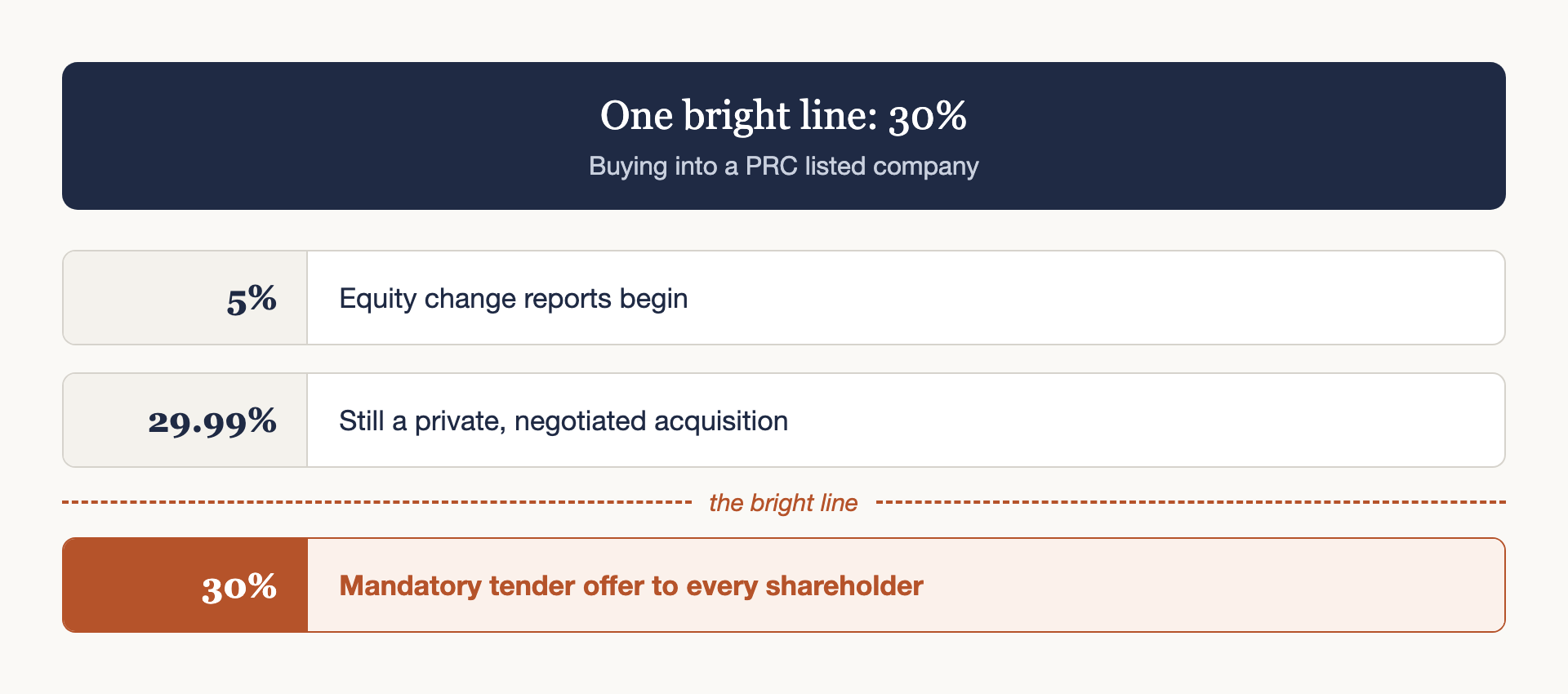
The rule sits in China's Takeover Measures. Specifically, it comes from the Administrative Measures for the Takeover of Listed Companies (as amended, effective February 19, 2025): Article 24 for purchases made through exchange trading, Article 47 for purchases made by agreement — the route this deal took — and Article 63 for the narrow set of exemptions available to an acquirer that crosses 30% anyway. Since a 2020 revision, qualifying for an exemption no longer requires prior approval from the securities regulator, but it still means a formal filing, and the burden of proof sits with the acquirer.
A tender offer is not a formality. It changes the economics of the deal. It changes the negotiating leverage. It changes who controls the timetable. For a family wanting a clean, negotiated exit, and a buyer wanting control without the cost and uncertainty of buying out the whole company, the incentive to stay under 30% is substantial.
Xia Zhisheng transferred 14.20% of the company; his son transferred 15.79%. The two figures add to 29.99%, not 30%, almost certainly not by coincidence. The public filing states plainly that the transaction does not trigger a tender offer obligation.
What 29.99% Doesn't Buy You
Staying under 30% avoids the tender offer trigger. It does not avoid the separate disclosure obligations that attach to a change in a company's controlling shareholder or actual controller. Zhejiang Meida announced, the same evening the agreement was signed, that its controlling shareholder was changing to Shenzhen Xinglantu Industrial Investment Partnership (Limited Partnership), a vehicle formed only nine days earlier, and that Zhang Haizheng was its new actual controller.
Under PRC Company Law, an actual controller is a person who, through an investment relationship, an agreement, or another arrangement, is able to actually direct the company's conduct — the definition in Article 265 of the 2023 Revision, effective July 1, 2024. The test does not require majority ownership, and since the 2023 revision it no longer requires that the person be something other than a shareholder. Before this deal, the Xia family's combined 52.41% stake was itself an aggregation: Xia Zhisheng, his son, his daughter, and his wife held their shares individually and were treated as joint actual controllers only because they were found to be acting in concert. None of them individually crossed 30% either.
The buyer's own structure mirrors the same lesson from the other direction. Xinglantu's general partner is majority-owned by Xingshang Innovation Technology (Shenzhen) Co., Ltd., a cross-border e-commerce group, which is itself controlled by Zhang Haizheng together with his mother, acting in concert. Reaching the individual who actually controls a PRC-listed company after a deal like this one routinely means following a chain of holding vehicles and concert-party relationships, not reading a single line on a shareholder register.
In transactions involving PRC-listed companies, I rarely see sophisticated buyers open the negotiation around the tender offer rule. In practice, price, lock-up terms, and payment mechanics get agreed first; the structuring below 30% is worked backward from those numbers once counsel is brought in. That sequencing matters, because it means the 29.99% figure in a deal like this one is usually the last number fixed, not the first.
In my experience advising on similar transactions, clients new to the PRC market often treat 29.99% as a number that buys them out of regulatory attention altogether. It does not. The Shenzhen Stock Exchange still had to confirm the transfer's compliance before registration could proceed, and the parties still built a set of protective terms that read more as a credibility signal to the market than as a strict legal requirement: a 36-month lock-up on the Xia family's remaining 22.42% stake, a 60-month lock-up on the buyer's new position, a 36-month undertaking against injecting related-party assets into the listed company, and a staged, escrow-monitored payment schedule tied to compliance confirmation and share registration.
Foreign investors evaluating acquisition targets in China frequently underestimate this distinction, and lawyers unfamiliar with China's takeover regime often make the same assumption: that the 30% line is a ceiling on control, not just a trigger for one obligation. Control can also arise from voting rights exercised through concert-party arrangements or voting delegations, from the power to appoint a majority of the board, or from the ability to materially influence resolutions at shareholders' meetings — the tests set out in Article 84 of the Takeover Measures. I would never advise a client to treat 29.99% as a safe harbor; I treat it as the start of governance diligence, not the end of it.
Practitioner's Note
The lawyers did not decide this deal. They decided how expensive it would become. A family exited at a price nobody forced them to accept, and a buyer secured control without a general offer it had no wish to make.
A set of lock-ups and an escrow arrangement gave the market reason to trust an acquisition vehicle incorporated nine days before it signed. None of that explains why the deal happened.
Xia Zhisheng's son took an economics doctorate and went into investing in Hong Kong. His daughter lasted four months as general manager before resigning. The company's first chairman from outside the founding family took over in 2023. Both children left the board in the June 2026 reshuffle, weeks before the sale was announced.
What decided this outcome was not the 30% threshold. It was a family that had already decided, years earlier, not to run a kitchenware factory. The statute only shaped how cleanly they could leave, not whether they would.
At the time of writing, the transfer remained subject to compliance confirmation by the Shenzhen Stock Exchange and completion of share registration, both disclosed as outstanding conditions.
Key Takeaways
- An agreement-based acquisition that crosses 30% of a PRC listed company's shares generally triggers a mandatory tender offer to all shareholders, unless an exemption under Article 63 applies (Takeover Measures, Arts. 47, 63).
- Staying below 30% avoids that specific obligation only. It does not avoid the separate disclosure duties triggered by a change of controlling shareholder or actual controller.
- "Actual controller" status under PRC Company Law does not require majority ownership. It can arise from concert-party arrangements, voting agreements, or control of the board (Company Law, Art. 265; Takeover Measures, Art. 84).
- In practice, the 29.99% figure in deals like this one is usually the last number the parties fix, not the first — commercial terms are agreed before counsel structures the stake around the threshold.
Frequently Asked Questions
Why didn't the buyer simply take 30%, or a controlling majority? Because crossing 30% by agreement (Takeover Measures, Art. 47) obligates the buyer to offer to buy out every other shareholder, at a price and on a timetable set largely by regulation — a slower, costlier, less certain path than acquiring just under the line.
Why stop at exactly 29.99%, rather than a rounder number? 29.99% is the practical ceiling for a privately negotiated stake under PRC takeover rules. Buyers and sellers routinely negotiate up to that ceiling to transfer as much control as possible while staying outside the tender offer requirement.
Can someone control a Chinese listed company without ever crossing 30%? Yes. Under Company Law Article 265 and Takeover Measures Article 84, actual control can arise from concert-party arrangements, voting agreements, or the power to appoint the board, independent of the 30% shareholding threshold.
Legal Authorities Cited
- PRC Company Law (2023 Revision, effective July 1, 2024), Article 265
- Administrative Measures for the Takeover of Listed Companies (as amended, effective February 19, 2025), Articles 24, 47, 63, 84
This article discusses a publicly disclosed transaction for illustrative purposes and reflects general principles of PRC law. It does not constitute legal advice and should not be relied upon in place of advice from qualified PRC counsel on any specific transaction.
Related Legal Analysis
- What Happens to Your Chinese Company When Its Actual Controller Dies
Distressed AssetsAnalysis11 min read
- A Daughter Tried to Remove Her 83-Year-Old Mother From the Board. She Failed.
Commercial DisputesAnalysis14 min read
- The Hidden Legal Risks in Acquiring a China Data Center — Part C: Money, Data & the People Who Keep the Lights On
Corporate TransactionsAnalysis9 min read
Related Practice Areas
If your business is facing similar issues, please contact me to discuss how I may assist.